- CSL
- Cours du soir
- Séminaires
- Diplôme d’accès aux études universitaires – option littéraire (DAEU-A)
- Formations universitaires
- Présentation
- Master Banque, Finance, Assurance, parcours Fonds et Gestion Privée
- Master Financial Analysis and Strategy
- Master Gestion des Ressources Humaines et Relations du Travail
- Master Management des Organisations du Secteur Sanitaire et Social
- Master Management et Administration des Entreprises
- Master Marketing et Communication
- Master MTECH Technopreneurship: mastering smart ICT, standardisation and digital trust for enabling next generation of ICT solutions
- Bachelor in Applied Information Technology – Continuing Education Programme
- Licence de Gestion
- Licence Métiers de la Gestion et de la Comptabilité (2 parcours)
- Diplôme Universitaire (DU*) de Sophrologie
- Conditions générales
- Formations spécialisées
- Certifications
- Formations pour seniors
- Formation professionnelle initiale
- Congés et aides financières
- En un coup d’œil
- Congé individuel de formation
- Congé linguistique
- Congé sans solde
- Aménagement personnel du temps de travail
- Déductibilité des dépenses de formation continue
- Aides financières pour études supérieures
- Aide financière pour la formation professionnelle des demandeurs d’emploi
- Remboursement des frais d’inscription dans le cadre de l’acquisition de la nationalité
- Cofinancement de la formation en entreprise
- Subvention pour cours de luxembourgeois en entreprise
- Autres dispositifs de soutien
“Acquire and sustainably transform your new digital skills into performance for career opportunities.”
Whether you’re interested in the digital field, looking for a job, in a general management or digital-focused position, or already working in a digital/IT operational area, it’s important to know that digital skills are essential these days and need to be updated regularly.
Businesses of all shapes and sizes need people who know how to operate, promote and communicate online. This makes digital skills crucial for current and future employees in all industries.
The LLLC accompanies you in this transition towards the development of your digital skills, thanks to “Digital skills training” in line with the current needs of the job market.
“Digital skills training” is a set of 7 training paths that allow you to acquire digital skills useful for creating and sharing digital content, communicating and collaborating effectively, and solving technical and commercial problems. And this whether in the field of Cloud, Cybersecurity, networks, …
Whichever training path you choose, you will be able to prepare for your career, or even update or develop new skills in your work or even in your daily life.
Networks Training path (CCNA)
With new technologies, networks are becoming smarter, more programmable, and more software-driven.
This training path consists of a series of 4 courses, which provide an understanding of network architectures, models, protocols, and elements to support business operations and priorities, as well as making appropriate decisions to mitigate threats and improve network security using access control lists.
You don’t know anything about it. No problem, you can start with the IT Essentials course. Then take the following courses until you pass the certification that will allow you to work as a network administrator (for example).
It is also possible to start with a more advanced course, such as “CCNA Switching, Routing and Wireless”, if you have already passed the previous course or if you pass the online test that shows you have the skills to enter the course.

The Fundationals:
- Course 1 : IT Essentials (+ lien menant à la page de description et d’inscription dans séminaire)
Becoming a professional:
- Course 2 : CCNA – Introduction to Networks
- Course 3 : CCNA – Switching, Routing and Wireless essentials (SRWE)
- Course 4 : CCNA – Entreprise Networking, Security and Automation (ENSA)
Cybersecurity Training path
Information security is an ongoing concern for companies, customers, providers and even individuals.
Cybersecurity issues are on everyone’s mind and require processes to be in place to know how to protect against hackers. Hackers are stepping up their efforts to break into companies, especially these days with telecommuting and nomadism.
The cybersecurity training path consists of 5 courses.
With this training path, cybersecurity beginners will learn how to protect themselves online and on social networks in an increasingly hyperconnected world from cyberattacks. And more experienced individuals will gain the skills to secure and protect their company’s networks from outside attacks so that a single security breach does not have disastrous consequences.
Industry-recognized certifications are available in the “Becoming a Professional” pathway, allowing learners to work as cybersecurity analysts or system administrators for example, and so on.
As with the “Network Training Path” or any other training path, you can start with the “Fundamentals” courses. You can also go directly to a more advanced course in the “Become professional” pathway if you have successfully completed one of the previous courses or an equivalent course, or if you pass a test proving that you have the necessary skills to take the course.

The Fundationals:
- Course 1 : IT Essentials
- Course 2 : Intro to Cyber
- Course 3 : Cybersecurity essentials
Becoming a professional:
- Course 4 : CompTIA Security +
- Course 5 : CyberOps Associate
Linux Training Path
One of the best known examples of open source, Linux has been widely used in enterprise servers, data centers, and mobile devices.
Whether you are taking your first steps into the digital world or are a future system administrator or programmer, this training is for you!
This Linux training includes 4 courses.
Thanks to the “The Fundationals” pathway, it leads beginners to discover the basics of Linux to interact with the Linux virtual machine: installation, basic configuration of Linux software, mastery of Linux commands.
And for the more experienced, intermediate to advanced modules are developed in the “Becoming a professional” pathway, including maintenance tasks using command lines, installation and configuration of Linux computers, and implementation of basic network functions with Linux virtual machines.
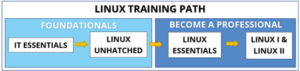
The Fundationals:
- Course 1 : IT Essentials
- Course 2 : Linux Unhatched
Become a professional:
- Course 3 : Linux Essentials
- Course 4 : Linux I & II
Cloud Training path - For people who work in the field of Management
This training path is designed to enable people in the management field to learn how to manage Cloud Computing and its services in a way that is applicable to everyday life.
It consists of 6 courses.
The “Fundationals” training path introduces learners to the basics of computer hardware and software as well as the best practices to properly protect themselves online against cyber attacks.
After making sure they have the right basics, the “Becoming a Professional” training path then provides the learner with the theoretical and practical technical knowledge to ensure a safe, efficient and secure cloud environment.
And can also be able to manage potential incidents by being part of the solution to get the most out of cloud technology decisions.
This will enable all staff members, not just IT staff, to make sound decisions.

The Fundationals:
- Course 1 : IT Essentials
- Course 2 : Intro to Cyber
- Course 3 : Cybersecurity essentials
Becoming a professional:
- Course 4 : CompTIA Cloud Essentials +
- Course 5 : CompTIA Cloud +
- Course 6 : Clouod Security
Cloud Training path – For people who work in the operational field
This training path consists of 5 modules focused on Microsoft Azure and Microsoft 365 services.
You are first guided through the “Fundamentals” training path to discover the basics of Microsoft Azure and Microsoft 365 so that beginners can learn the basics of the cloud, but also get an overview of cloud computing. You’ll also learn how to improve productivity, facilitate collaboration and optimize communications.
In the “Becoming a Professional” training path, you’ll go further in discovering the cloud computing environment by learning how to administer it by implementing, managing and securing identity, user access to your organization’s resources, governance, storage, compute and virtual networks.
Last but not least, you will learn how to maintain an organization’s security posture and identify and remediate security vulnerabilities.

The Fundationals:
- Course 1 : Microsoft Azure Fundamentals
- Course 2 : Microsoft 365 Fundamentals
Become a professional:
- Course 3 : Microsoft Azure Administrator
- Course 4 : Microsoft Azure Security Technologies
- Course 5 : Microsoft 365 Security Administration
Devnet Training path
In the “Devnet Training path” (consisting of 4 courses) like many of the other training paths, you start with a good computer foundation with the “IT Essentials” course, which covers the fundamental computer and job skills for entry-level computer jobs.
Then move on to the architectures, models, protocols and network elements that connect users, devices, applications and data through the Internet and modern computer networks – including IP addressing and the fundamentals of Ethernet.
After developing an overview of the work environment, you can now learn the Python programming language that will allow you to work in software development positions, …
The DevOps course in the “Becoming a professional” training path will take you further into software development. You will learn how to safely interact with application programming interfaces (APIs) to automate existing manual processes with only a few lines of code.
By the end of this training path, you will have developed the skills necessary to work in the field of software development and infrastructure automation.

The Fundationals:
- Course 1 : IT Essentials
- Course 2 : CCNA – Introduction to Networks
- Course 3 : PCAP – Programming essentials in Python
Become a professional:
- Course 4 : Devnet Associate
Programming Training path
This training path includes two courses that you can join without any prerequisites and that each have the objective of teaching you how to program.
The use of the programming languages Javascript and Python will allow you to develop the best programming practices, know the coding concepts, … but also debugging and troubleshooting.
Programming skills open up careers in almost every industry and are necessary if you want to pursue more advanced software development and engineering positions.
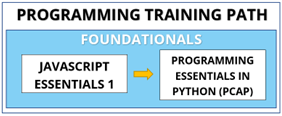
The Fundationals:
- Course 1 : Javascript Essentials 1
- Course 2 : PCAP – Programming essentials in Python
All courses in the 7 training paths are open for registration.
It is possible to follow a training path as a whole. Or, if you already have some knowledge, you can take the test or show that you have passed the previous module to enter directly into the intermediate or advanced modules.
In addition, these modules are delivered in a blended learning format and allow you to develop the skills in demand in the industry through face-to-face classes with certified instructors in a lab equipped with servers, routers, cabling, laptops, etc., as well as online classes and labs incorporating virtualization and network simulation tools.
It is then possible to maximize the learning of theoretical concepts by applying them directly to real-life situations.
With these new digital skills, you will be better able to prepare your career or update your skills in your job to succeed in the increasingly technology-driven Luxembourg job market.
Nota bene:
However, if you enroll in the CCNA training path courses, it is strongly recommended that you only take this training path due to the workload involved.
Similarly, for the CyberOps Associate course and the Linux I and II course, which run concurrently, due to the workload, it is also strongly recommended that you enroll in one or the other.
Materials needed to take a course:
By bringing your own laptop that meets these specifications, the course material can be installed on it and you will be able to practice outside of class sessions.
To take these courses, you will need a laptop with the following specifications:
- CPU: Intel Core i5, or equivalent or higher recommended
- RAM: Minimum 8 GB Ram, 16 GB recommended
- Minimum SSD hard drive, >500 GB recommended
- Network:
- Wifi at least compatible with 802.11ac standard.
- Ethernet network card recommended or use of an external Ethernet to adapter USB>RJ45
- Supported operating systems (for Virtual Box & Packet Tracer): Windows 10-11, (MacOS >10.14)
- Minimum of 1 free USB Type A port required for some Cisco courses (use of USB console cables).
- Participants must have administrator access on their laptop for Cisco courses (important for participants who take a laptop from their employer) to allow:
- installation of Cisco Packet Tracer
- installation of Oracle Virtual Box
- installation of the Cisco USB console cable driver or network adapter
- installation and execution of putty, etc.