- CSL
- Who is the CSL?
- Missions and activities
- Structure
- Plenary assembly
- Members
- Commission
- Internal Commissions
- Commission on Economic Affairs, Taxation and Budgetary Policy
- Commission on Social Affairs, Health and Safety at Work and the Environment
- Commission on European and Interregional Affairs
- Commission on Vocational Training and Continuing Education
- Commission for crossborder work
- Commission for demographic ageing and its impact on society
- Equality Committee
- Finance Commission
- Commission on the situation of young people in the modern labour market
- Secretariat
- At a glance
- History
- Opinions
- Position papers
- Your rights
- Employees
- Types of employment
- Trial period
- Remuneration
- Definition of the term “remuneration”
- Wage level
- Collective bargaining agreement wage scales
- Salary supplements
- Premium payments
- Wage indexing
- Payment of wages
- Garnishment and assignment
- What is meant by wage garnishment?
- What part of a person’s salary can be garnished?
- Is garnishment carried out on gross or net pay?
- What happens if several garnishment actions are carried out on a single pay source?
- How is the garnishing of wages carried out in the case of a maintenance claim?
- What is the difference between a garnishment of earnings and an assignment of earnings?
- Deductions from wages
- Salary comparison
- Working time
- Basic principles
- Who is covered by the legal strictures on working time?
- Who is to be considered a senior manager?
- What is meant by working time?
- How many hours per day and per week can employees work?
- Can an employee have several jobs?
- How is the working week split into days?
- At what time must the employee report to work and what rest period is required during a shift?
- Is an employer entitled to unilaterally change the working hours of employees?
- Can an employer unilaterally change the distribution of weekly working hours over the days of the week?
- Are employers obliged to set up a system for recording working hours?
- Part-time work
- What is meant by part-time work?
- What special information is included in part-time employment contracts?
- Do employers have to offer part-time work to employees who request it?
- Can an employee refuse to work part-time?
- What are the rights of part-time employees?
- Part-time workers and the work organisation plan (WOP): what conditions must be fulfilled?
- Can an employer force a part-time employee to work overtime?
- Minimum rest period
- Overtime
- Sunday work
- Night work
- Work on public holiday
- What employees are involved?
- Which days qualify as legal holidays?
- What happens when a legal holiday occurs on a Sunday?
- What happens when a legal holiday occurs on a working day that has been declared a “working day not worked”?
- What happens when a legal holiday occurs on a working day?
- If a public holiday falls during a period when the employee is off sick, can compensatory leave be awarded later?
- How is work on legal holidays paid?
- How is work on a public holiday that is also a Sunday paid?
- How is work on legal holidays paid in companies working on a seasonal basis?
- What about young workers who work on a legal holiday?
- Are employers required to keep a separate register for holiday work?
- Flexible working time arrangements
- What is meant by flexible working time arrangements?
- What is meant by work organisation plans (WOP)?
- What about overtime in a WOP?
- What are the rules protecting night workers under a WOP?
- What are the rules protecting part-time workers under a WOP?
- What are the rules protecting young workers that form part of the WOP?
- How long can a reference period last?
- What is flexitime?
- Young people
- What are young workers?
- What is meant by working time for young workers?
- What are the limits to working time applicable to young workers?
- What are the young worker's rest periods?
- Can young workers work overtime?
- Can young workers work at night?
- Can young workers work on Sundays or legal holidays?
- Can the working hours of young workers be made flexible?
- Pregnancies
- Time savings account (CET)
- How are time savings accounts set up?
- When was this introduced into the Labour Code?
- How are contributions to a time savings account made?
- How does one use a time savings account?
- How are employees protected?
- How is a time savings account liquidated?
- What are an employer’s obligations?
- What guarantees are in place in case of employer bankruptcy?
- What about current collective bargaining wage scales?
- What is the task of the staff delegation with regard to the time savings account?
- What is the impact of a time-saving account on unemployment benefits?
- What is the tax treatment of time savings accounts?
- Flexible working arrangements
- What are the qualifying conditions?
- What are "flexible working arrangements"?
- How can the employer respond?
- How is the return to the original working arrangement organised?
- Is the employee protected against dismissal?
- Are the employment and the rights attached to it to be maintained?
- Can an employee be subject to reprisals or less favourable treatment?
- What are the penalties for non-compliance?
- CSL publication
- Basic principles
- Changes in working conditions
- Statutory leaves
- Overview
- Annual recreation leave
- Extraordinary leave
- What family event qualifies for extraordinary leave?
- When is an employee entitled to leave for reasons of force majeure?
- How long is the leave for reasons of force majeure?
- What is the caregiver leave?
- How long is caregiver leave?
- What should an employee do if he intends to take leave for reasons of force majeure or carergiver leave?
- Can extraordinary leave be carried over?
- Can a newly hired employee take extraordinary leave without waiting for the three-month period to expire?
- How many times can extraordinary leave for moving house be taken?
- Can extraordinary leave be awarded if the family event occurs during a period of illness?
- If an event occurs during a period of regular leave, is extraordinary leave due?
- Who pays for the extraordinary leave?
- What are the terms and conditions for taking the 10-day leave for the birth or adoption of a child?
- Are part-time employees entitled to the same number of special leave days?
- How can employees in a civil union get extraordinary leave?
- Are employees in a union under foreign law eligible for extraordinary leave?
- How are employees protected during extraordinary leave?
- Family-related leave
- Training-related leave
- Sports leave
- What is the purpose of sports leave?
- Who is entitled to sports leave?
- What are the conditions for taking sports leave?
- How long does sports leave last?
- Does sports leave count as working time?
- Can sports leave be split?
- Can the duration of sports leave be prorated?
- Is the sports leave cumulative?
- Can sports leave be postponed from one year to the next?
- How do I apply for sports leave?
- Can the employer refuse sports leave?
- How is sports leave paid?
- Leave related to an employee’s status as an elected official
- Development cooperation leave
- What is the purpose of development cooperation leave?
- Who is eligible for development cooperation leave?
- Which type of missions are eligible for development cooperation leave?
- What process should be followed to obtain development cooperation leave?
- How long is development cooperation leave?
- Is development cooperation leave considered as actual working time?
- Special leave for volunteer firefighters
- What is the purpose of special leave for volunteer firefighters?
- Who is eligible for this type of leave?
- What training activities are eligible?
- How much time off do volunteer firefighters get?
- Who should volunteer firefighters apply to for leave?
- Can employers object to the leave?
- Is the leave for relief volunteers considered as a period of actual work?
- Who pays for special leave for volunteer firefighters?
- Leave to seek new employment
- CSL Publication
- Illness
- Obligations of the employee
- Employer’s obligations
- Termination of contract due to illness
- Health assessments
- Leave entitlement
- Progressive return to work for therapeutic reasons
- What is meant by a progressive return to work for therapeutic reasons?
- How does one apply for a gradual return to work for therapeutic reasons?
- Do I need the employer's consent?
- What are the consequences for the employee?
- Do employees who are progressively returning to work get their entire statutory leave?
- Reclassification
- What does the Social Security Medical Board (CMSS) do with a long-term sick employee?
- What happens if CMSS considers the employee fit for work?
- What happens if CMSS considers that the illness is lasting?
- What happens if the CMSS discovers a disability?
- What happens if CMSS recommends internal or external reclassification?
- Am I protected against dismissal?
- Can I be internally reclassified?
- Can I be reclassified externally?
- CSL publication
- Workplace monitoring
- Which people are protected by law?
- What is meant by personal data?
- What is meant by processing of personal data?
- Who is responsible for the data processing when it is carried out?
- What rules and conditions must be complied with by anyone who intends to set up a personal data processing system?
- When can personal data be processed?
- Under what conditions can an employer process personal data for surveillance purposes in the workplace?
- What are the rights of the person whose data is processed?
- CSL Publication
- Posting of employees
- What is a posted employee?
- To whom do the posting rules apply?
- Under what conditions is a posting possible?
- When can a posting be made?
- What about posting for temporary work agencies or companies that post their employees as a temporary loan of labour?
- What about doubts as to the reality of a posting or as to whether a company carries out a real and substantial economic activity in its country of origin?
- What are the rights of a posted employee?
- What is the maximum duration of a posting?
- What about initial assembly or first-time installation work?
- What about expenses related to the posting?
- What is the process for posting an employee to Luxembourg?
- What are the obligations of the principal or the client?
- What are the obligations of a client with regard to temporary work or the temporary loan of labour?
- What are the accommodation conditions for an employee who is away from his usual place of work?
- Which national authority controls the application of the posting rules?
- What penalties exist in the area of posting?
- End of employment contracts
- Dismissal
- Resignation
- In what form should a resignation be submitted to an employer?
- Must an employer be informed of the reason for a resignation?
- What is the notice period for resignation?
- What is the starting point of the notice period?
- What is the penalty if an employee fails to comply with the notice period?
- Can the notice period be offset against the employee's remaining leave?
- Can a person be exempted from serving a notice period following a resignation?
- In what cases can a person resign without notice?
- Si je démissionne, est-ce que j’ai droit à des indemnités ?
- Legal action for wrongful dismissal
- Imprisonment
- Automatic termination of employment contract
- Certificate of employment
- Does the employer have to issue a work certificate at the end of the employment contract?
- Does an employment certificate have to be issued for an employee with a fixed-term employment contract?
- What if the employer refuses to issue a work certificate despite the employee's request?
- What should an employment certificate contain?
- What to do if the certificate contains unfavourable statements?
- Non-competition clause
- What is a non-competition clause?
- Can an employer prohibit an employee from being poached by a competitor?
- Can a non-competition clause result from a verbal agreement between the employer and the employee?
- Under what conditions is a non-competition clause valid?
- Can a non-competition clause be added to an employment contract during its term?
- Business ownership transfer
- What is meant by a business transfer?
- What is meant by a transferor?
- What is a transferee?
- To whom do the rules on the employment of employees apply in the event of a business transfer?
- What happens to employees' employment contracts when ownership of a business is transferred?
- What about the transferor and transferee's liability?
- What are the obligations of the transferor and the transferee?
- What about the collective rights of employees in the event of a company transfer?
- Can the transfer of a business be a reason for dismissal?
- What obligations do the transferor and the transferee have with regard to providing information and consultations?
- What is the impact of the transfer on the status of employee representatives?
- Unemployment compensation
- Who can be compensated for the loss of a job?
- How can a person receive unemployment benefits?
- How long can the unemployed person receive benefits?
- Are unemployment benefits payable if I lose my part-time job?
- Are employees who are ill at the end of their notice periods entitled to unemployment benefits?
- How much are unemployment benefits?
- Are unemployment benefits reduced if an unemployed person earns money intermittently?
- When do unemployment benefits end?
- Legal action before the Labour Tribunal
- Health & safety in the workplace
- Employees concerned
- Responsible players
- Occupational Health Services
- Pre-employment medical examination
- Are employees required to undergo a pre-employment medical examination?
- What is the purpose of the pre-hiring medical examination?
- In what cases are employees subject to periodic medical examinations?
- What is an at-risk position?
- What if an employee has been declared fit for work?
- What if an employee has been declared unfit for work?
- Place of work
- Illness
- Reclassification
- What does the Social Security Medical Board (CMSS) do with a long-term sick employee?
- What happens if CMSS considers the employee fit for work?
- What happens if CMSS considers that the illness is lasting?
- What happens if the CMSS discovers a disability?
- What happens if CMSS recommends internal or external reclassification?
- Am I protected against dismissal?
- Can I be internally reclassified?
- Can I be reclassified externally?
- CSL publication
- Occupational accidents and diseases
- Pregnant women, young people and disabled workers
- Harassment
- Discrimination
- Alcohol, drug abuse, smoking
- Social dialogue
- Staff representation
- Setting up staff delegations
- Composition of the staff delegation
- Appointment of the staff delegation
- Duration and end of the mandate
- Remit of the staff delegation
- Health and Safety Representative
- Equal Opportunity Officer
- Resources available to the staff delegation
- Organization and functioning
- Status of employee delegates
- Litigation
- Délégation au niveau de l’entité économique et sociale
- Employee representatives in limited companies
- Collective labour agreements
- National Conciliation Office (ONC)
- Negotiation of a collective labour agreement
- Parties to the collective agreement
- Agreements on inter-professional social dialogue
- Observatoire des relations professionnelles et de l’emploi (ORPE)
- Arbitration
- Content of the collective labour agreement
- Signature and entry into force of the collective agreement
- Staff representation
- Third country nationals
- Definitions
- Stay of less than three months
- Stay of more than three months
- Residence permit for highly skilled employment
- Work permits for seasonal workers
- Residence and work permit for self-employed persons and investors
- Residence permits for athletes
- Residence permit for students, pupils, trainees, volunteers or au pairs
- Residence permit for researchers
- Family reunification
- International protection
- Frontier workers
- Youth
- Permanent employment contract (CDI)
- Employing school pupils and students on fixed-term contracts (CDD)
- What are the features of this type of employment?
- Who can benefit from this arrangement?
- What is the maximum working time?
- What is the maximum duration of the contract?
- Is it necessary to enter into a contract?
- What should the contract say?
- How much is the pupil’s/student’s pay in such a fixed-term contract (CDD)?
- Does the pupil/student need to be registered for social security?
- Does the pupil or student have to pay tax?
- Is the pupil/student entitled to state financial assistance for higher education?
- Is the pupil/student entitled to days off and statutory holidays?
- Do trainees who are minors enjoy special protection by virtue of their age?
- Can the contract be terminated before it expires?
- Who supervises the employment of pupils and students outside the school holidays?
- Which court has jurisdiction in case of disputes?
- Initial professional training
- Public school system
- Professional training courses
- Which vocational courses include internships?
- How do I find an internship position?
- Do I have to sign an internship agreement?
- What should the student intern commit to?
- What does the training organization have to commit to?
- What are the responsibilities of tutors in the school and professional environment?
- How is the placement course evaluated?
- What is the daily attendance time of student trainees in the training organization?
- Do student trainees get school holidays and vacations?
- Do student trainees receive compensation during the internship?
- What should the student trainee do in case of illness or absence?
- Are student trainees insured against accidents?
- What other protective provisions apply to student trainees?
- What happens if the course is interrupted?
- Can the internship agreement be interrupted?
- Useful information
- Employing school pupils and college students during academic holidays
- What are the features of this type of employment?
- Who can work as a pupil or student during academic vacations?
- Is there a maximum employment time?
- Is it necessary to enter into a contract?
- What should the contract say?
- How much is the pupil's/student's remuneration?
- Do pupils/students have to pay taxes?
- Is the pupil/student entitled to state financial assistance for higher education?
- Does the pupil/student need to be registered for social security?
- Is the pupil/student entitled to time off?
- Do pupils/students benefit from special protection?
- Can the contract be terminated before it expires?
- Who supervises the employment of pupils/students?
- Which court has jurisdiction in case of disputes?
- Internship
- Employment support contract (CAE)
- Who is eligible?
- How to find an available position?
- How is the contract concluded?
- How long does it last?
- How long does the young person work?
- How is the young person supervised?
- How is a young person evaluated?
- What is the young person's remuneration?
- What are the common law rules that apply?
- What are the young person's obligations?
- What assistance is available to the employer?
- How is the employer encouraged to hire the young person at the end of the contract?
- How does the contract end?
- CSL Publication and Case law
- Employment initiation contract (CIE)
- Who is eligible?
- How to find an available position?
- How is the contract concluded?
- How long does it last?
- How long does the young person work?
- How are young persons supervised?
- How is the young person evaluated?
- What is the young person's remuneration?
- What are the common law rules that apply?
- What assistance is available to the employer?
- How is the employer encouraged to hire the young person at the end of the contract?
- How does the contract end?
- What are the employer's obligations at the end of the contract?
- CSL Publication and Case law
- Working time
- What are young workers?
- What is meant by working time for young workers?
- What are the limits to working time applicable to young workers?
- What are the young worker's rest periods?
- Can young workers work overtime?
- Can young workers work at night?
- Can young workers work on Sundays or legal holidays?
- Can the working hours of young workers be made flexible?
- Social security
- Accidents
- Dependency
- Pensions
- General provisions
- Historical overview of the general pension insurance scheme
- The different pension schemes in Luxembourg
- The functioning of the general pension insurance scheme
- The affiliation to the general pension insurance scheme
- The financing of the general pension insurance scheme
- The deductions on pensions and social security affiliation
- The reimbursement of contributions
- The appeal procedures
- Old-age pension
- Invalidity pension
- Survivor’s pension
- Estimating your pension
- Important questions – easily explained
- I am preparing my pension application...
- I have children...
- I work part-time
- I want my studies to be recognised for pension purposes...
- I wish to insure myself / pay contributions on a voluntary basis...
- I am interested in the purchase of periods...
- I have worked in several countries...
- The date if entitlement to the pension...
- The amount of my pension...
- I receive a pension and I continue to work...
- I receive a pension and I live abroad...
- I have become invalid...
- Regarding the survivor's pension...
- Useful information
- General provisions
- Aid
- Unemployment
- Family benefits
- What are the main amounts related to family benefits?
- The Children's Future Fund
- What are the different types of family benefits?
- What are the steps to obtain the benefits?
- What about payment of benefits?
- How are family benefits organised in the EU?
- What about the prescription of benefits?
- What about the assignment, pledging and seizure of benefits?
- What about undue benefits?
- What about penal provisions?
- Useful information
- CSL Publication
- REVIS
- What is a Social Inclusion Income (REVIS)?
- Who can benefit from REVIS?
- How is the REVIS calculated?
- Under what circumstances should the inclusion allowance be returned?
- How do I apply for a REVIS?
- What transitional provisions apply to recipients of the RMG?
- What are the remedies?
- What other public aid is available?
- Useful informations
- CSL Publication
- Housing
- Educational bursaries
- How has the graduate financial aid system evolved in recent years?
- What is new with the 29 October 2019 law?
- Who is eligible for state student financial aid?
- What financial aid is available to students?
- For how many semesters can a student receive financial aid?
- What steps must a student take to receive graduate financial aid?
- What documents should be submitted with an application for financial aid?
- What appeals of a decision to refuse financial aid are possible?
- Payroll taxation
- Legal library
- Employees
- Health, well-being and security at work
- Quality of Work Index Luxembourg
- Stressberodung
- Preventing psychosocial risks
- Your rights: Health & safety in the workplace
- Awareness campaign “Prevention of health risks in the workplace”
- Newsletter
- Initial professional training
- Presentation
- Public school system
- Apprenticeship
- Ready for an apprenticeship? Here's how to get started...
- What are the advantages of a vocational training under an apprenticeship contract?
- How does a typical apprenticeship training program work?
- Which trades / professions are organized under an apprenticeship contract?
- What are the rights and obligations of an apprentice?
- Who should the apprentice talk to during their apprenticeship?
- What about adult education?
- What about cross-border learning?
- What about apprenticeship benefits?
- Professional training courses
- Which vocational courses include internships?
- How do I find an internship position?
- Do I have to sign an internship agreement?
- What should the student intern commit to?
- What does the training organization have to commit to?
- What are the responsibilities of tutors in the school and professional environment?
- How is the placement course evaluated?
- What is the daily attendance time of student trainees in the training organization?
- Do student trainees get school holidays and vacations?
- Do student trainees receive compensation during the internship?
- What should the student trainee do in case of illness or absence?
- Are student trainees insured against accidents?
- What other protective provisions apply to student trainees?
- What happens if the course is interrupted?
- Can the internship agreement be interrupted?
- Useful information
- Economic pages
- Events
- Library
- 100 years CSL
The pension application and its processing
The pension application
Invalidity pensions are only granted upon formal application by the interested parties using the relevant form. The personal situation of the applicant may determine the procedure to be followed for submitting the application.
An employee unable to occupy their post for health reasons must consult a doctor to obtain a certificate of incapacity for work to be sent to the National Health Fund (CNS – Caisse nationale de santé). The latter grants sickness cash benefits. In the event of prolonged absence, the Social Security Medical Board (CMSS – Contrôle médical de la sécurité sociale) seeks to ascertain whether the cessation of work is due to a temporary illness or whether it constitutes an invalidity. If the CMSS comes to the conclusion that it is indeed a lasting invalidity, it informs the insured person, the CNS and the employer. The insured person’s employment contract then ceases automatically, without any decision by the employer being necessary. This may occur before the expiry of the 78th week of incapacity for work over the reference period of 104 weeks.
The insured person must then promptly submit their invalidity pension application to the National Pension Insurance Fund (CNAP – Caisse nationale d’assurance pension), knowing that during the processing period they will no longer receive a salary. Once the processing is complete, the pension is granted or rejected by a decision subject to appeal. (See section ‘The appeal procedures‘)
If the interested party has already ceased their professional occupation for some time, sickness cash benefits are not payable by the CNS. The insured person then directly submits their invalidity pension application to the CNAP. The latter instructs the attending physician to draw up a medical report. If, on the basis of this report, the CMSS reaches the conclusion that it is indeed a lasting invalidity, and if the insured person fulfils the other conditions for the granting of the invalidity pension, the invalidity pension is granted by the CNAP.
If the invalidity is the consequence of an occupational accident, it is not sufficient to apply for the granting of a pension from the Accident Insurance Association (AAA); an application for the granting of an invalidity pension must also be submitted to the CNAP. If the invalidity is entirely attributable to the occupational accident, it is not necessary to enclose a medical certificate, as the opinion of the CMSS is based on the file concerning the accident.
(last updated on 29 June 2026)
The competent pension fund
Just as for the old-age pension, the invalidity pension application is to be submitted to the pension fund either of the last country in which the employee was insured under pension insurance, or of the country of residence. Where the insured person has a mixed career in several countries, the CNAP will liaise with the competent pension bodies of the respective countries with a view to examining the pension entitlements in those countries.
(last updated on 29 June 2026)
The payment of the pension
In principle, the insured person receives a pension from each State in which they worked – subject to the condition that they fulfil the conditions for the granting of the invalidity pension of each of those countries.
(last updated on 29 June 2026)
The conditions for entitlement
The medical condition
To be entitled to an invalidity pension, the medical criterion of invalidity must be recognised by the Social Security Medical Board (CMSS). An insured person is considered as suffering from invalidity where, as a result of prolonged illness, infirmity or wear, they have suffered a loss of working capacity such that they are unable to carry on the occupation they last exercised or any other occupation corresponding to their abilities.
Until the age of 50, the insured person must follow any medical, professional or social rehabilitation or retraining measures that may be prescribed by the pension fund on the recommendation of the CMSS, failing which their pension may be suspended.
ATTENTION: The invalidity criteria differ from one country to another, so that an insured person who is declared invalid in Luxembourg may not be considered as invalid in another country in which they worked, or vice versa.
Thus, an insured person who has a professional career in several countries may end up not receiving an invalidity pension in each of those countries.
Indeed, among its bilateral agreements, Luxembourg knows only one convention providing for the mutual recognition of the invalidity status of an insured person, namely the one concluded with Portugal.
(last updated on 29 June 2026)
The qualifying period condition
In addition, the insured person must demonstrate a qualifying period of at least 12 months of insurance under compulsory, continued or optional insurance during the 3 years preceding the date of the invalidity established by the CMSS or the expiry of the sickness cash benefits. This 3-year reference period is extended insofar as and to the extent that it overlaps with additional periods or periods corresponding to the receipt of the inclusion allowance of the social inclusion income (REVIS) or the income for severely disabled persons (RPGH). (See sections ‘The different types of insurance periods’ and ‘Additional periods‘)
However, this qualifying period is not required in the event of invalidity of the insured person attributable to an accident of any nature or a recognised occupational disease during the affiliation.
(last updated on 29 June 2026)
The age condition
In order to be eligible for an invalidity pension, the insured person must moreover be aged less than 65 years.
(last updated on 29 June 2026)
The income condition
Finally, the granting of the invalidity pension is subject to the condition that the interested party renounces, in Luxembourg or abroad, any professional activity other than an insignificant one, that is to say yielding an income which does not exceed one third of the unskilled social minimum wage. One-third of the minimum wage currently amounts to 923.78 euros as at 1 June 2026.
(last updated on 29 June 2026)
The start and end of the invalidity pension entitlement
The start of the invalidity pension
The invalidity pension runs from the first day of the established invalidity, but at the earliest on the day on which the qualifying period and income conditions are fulfilled. In the event of legal or contractual maintenance of the remuneration of the salaried activity exercised before the occurrence of the risk, it only runs from the day of cessation of that remuneration.
If the invalidity is mainly due to an occupational accident occurring or an occupational disease declared after 31 December 2010, the invalidity pension only begins from the date of consolidation. The consolidation of the invalidity is the point at which, following the period of treatment, the injury becomes fixed and takes on a definitive character, such that treatment is in principle no longer necessary except to avoid an aggravation, and it is possible to assess a certain degree of permanent incapacity resulting from the accident, subject to possible relapses and revisions.
For the period during which the insured person in receipt of an invalidity pension also received sickness cash benefits from the Luxembourg insurance scheme arising from the professional activity exercised before the occurrence of the risk, the invalidity pension is paid to the competent healthcare fund. Where the invalidity pension exceeds the sickness cash benefits, the healthcare fund transmits the difference, if any, to the insured person.
If the date of the start of the invalidity cannot be established, it is deemed to be the day on which the application for the granting of the pension was received by the National Pension Insurance Fund (CNAP – Caisse nationale d’assurance pension).
Where the invalidity is only of a temporary nature, the pension begins on the expiry of the entitlement to sickness cash benefits or, in the absence of such an entitlement, on the expiry of an uninterrupted period of invalidity of 6 months. The invalidity pension is not granted for a period more than one year prior to the receipt of the application.
Where the pension had already been granted for a limited period, it is re-granted in the event of relapse from the first day of the new period of invalidity, as long as the entitlement to sickness cash benefits has not been reestablished.
(last updated on 29 June 2026)
The end of the invalidity pension
In principle, and with the exception of temporary invalidity pensions, the invalidity pension is paid until the insured person reaches the age of 65. However, the invalidity pension is withdrawn if the beneficiary no longer fulfils the invalidity conditions or if they exercise a professional yielding an income activity exceeding one third of the unskilled social minimum wage.
Without any formal decision being required to this effect, all invalidity pensions in payment are converted into old-age pensions when the beneficiaries have reached the age of 65.
Where the beneficiary can demonstrate contributory incomes credited under compulsory insurance situated during the period of benefit of the invalidity pension, a new calculation of the proportional increases is carried out and, where applicable, a reduction of the minimum pension supplement, without the total amount of the pension being able to suffer a decrease.
(last updated on 29 June 2026)
The calculation of the invalidity pension
Just like the old-age pension, the monthly invalidity pension is composed of an element proportional to the contributory incomes and a lump-sum element depending solely on the number of years of insurance.
To the monthly pension is added, for the month of December, the end-of-year allowance.
The calculation of pensions is carried out first at index number 100 of the cost of living as at 1 January 1948 and for the base year 1984. This makes it possible to compare salaries from different years. Once this step has been carried out, pensions benefit from a dual adjustment. Just like old-age pensions, they are adjusted to the evolution of real wages (revaluation and readjustment) as well as to the cost of living (indexation). (See section ‘Indexation, revaluation and readjustment‘)
ATTENTION: The level of the invalidity pension does not correspond to a fixed percentage of the last salary received by the insured person!
(last updated on 29 June 2026)
The lump-sum increases
The lump-sum increases in the context of the invalidity pension are composed of two parts: the so-called ‘normal‘ lump-sum increases and the special lump-sum increases.
The so-called ‘normal‘ lump-sum increases are determined in the same manner as for the old-age pension. They therefore depend on the number of years of insurance that the insured person can demonstrate before the invalidity pension entitlement. (See section ‘The lump-sum increases‘)
The special lump-sum increases fictitiously extend the insurance career up to the age of 65 of the insured person claiming the invalidity pension, taking into account that the insured person’s number of years of insurance could have continued to increase had they not become invalid.
Specifically, the special lump-sum increases correspond to as many fortieths of the product of the multiplication of the rate of lump-sum increases by the reference amount (2,085 euros per year, at index number 100 of the cost of living as at 1 January 1948 and base year 1984) as there are years missing between the start of the invalidity pension entitlement and the age of 65 completed, without the number of years credited being able to exceed, taking into account the ‘normal‘ lump-sum increases, 40. A commenced year counts as a full year.
However, the crediting of the prospective periods which fictitiously extend the insured person’s career to the age of 65 for the special lump-sum increases is only carried out in full if the insured person can demonstrate an uninterrupted insurance career prior to the occurrence of the risk. Otherwise, they are only allocated in the proportion of the number of years of insurance periods completed from the age of 25 relative to the number of years between that age and the occurrence of the risk (if the density of the insurance career between the age of 25 and the start of the invalidity is 80%, the prospective periods can only be taken into account in the same proportion).
(last updated on 29 June 2026)
The proportional increases
The proportional increases in the context of the invalidity pension are also composed of two parts: the so-called ‘normal‘ proportional increases and the special proportional increases.
The so-called ‘normal‘ proportional increases are determined in the same manner as for the old-age pension. They therefore depend on the sum of all the contributory incomes that the insured person can demonstrate before the invalidity pension entitlement. (See section ‘The proportional increases‘)
The special proportional increases fictitiously extend the insurance career up to the age of 55 of the insured person claiming the invalidity pension, taking into account that the sum of the insured person’s contributory incomes could have continued to increase had they not become invalid. This fictitious extension is made on the assumption that the insured person would have had the same contributory incomes in the future as in the past.
The special proportional increases correspond to the product resulting from the multiplication of the rate of proportional increases applied to the reference base by the number of years remaining from the start of the pension entitlement to the completion of the 55th year of age. The reference base is a fictitious income established by dividing the amount of contributory incomes credited between the start of the calendar year following the one in which the insured person completed the age of 24 and the occurrence of the risk, by the number of years of this same period. However, periods of receipt of a prior invalidity pension, periods of non-compensated vocational training, waiting periods for unemployment compensation, child-raising periods, as well as periods from 1 January 1990 during which the interested party provided care to a dependent person may be neutralised in the denominator.
(last updated on 29 June 2026)
The end-of-year allowance
The beneficiary of an invalidity pension is entitled to an end-of-year allowance under the same conditions and calculated in the same manner as for old-age pensions. (See section ‘The end-of-year allowance‘)
(last updated on 29 June 2026)
The minimum pension
As for the old-age pension, no invalidity pension may be less than 90% of the reference amount where the insured person has completed a qualifying period of 40 years. (See section ‘The minimum pension‘)
The minimum pension corresponds in June 2026 to a monthly amount of 2,436.04 euros for a career of at least 40 years.
By analogy with the special lump-sum increases, to complete the aforementioned qualifying period, the number of years missing between the start of the pension entitlement and the age of 65 is taken into account, without the total number of years being able to exceed 40.
Where the invalidity occurs after the age of 25, the number of missing years is only taken into account in the proportion of the total insurance duration between the start of the year following the one in which the insured person completed the age of 24 and the occurrence of the risk, relative to the total duration of the calendar years of that period.
(last updated on 29 June 2026)
Examples of invalidity pension calculations
Example 1 – Luxembourg career
Marie-Juliette was born on 14 December 1989. She studied until 15 November 2010 before starting to work. She demonstrates an insurance career – as shown on her career statement – as follows:
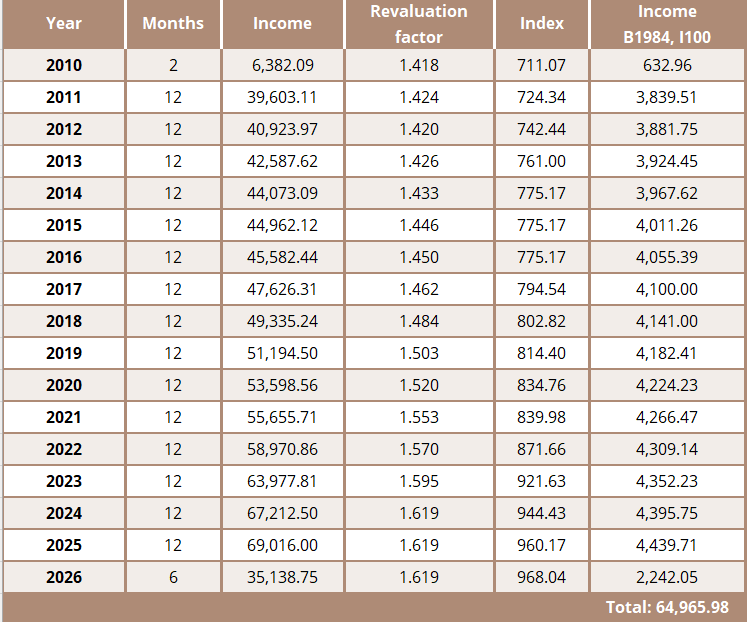
On 1 July 2026, at the age of 37, Marie-Juliette becomes invalid and begins receiving an invalidity pension from that date. To determine the amount of her pension, it is necessary to calculate the lump-sum increases as well as the proportional increases.
The lump-sum increases
The so-called ‘normal‘ lump-sum increases are granted according to the number of years of insurance that the insured person can demonstrate before the invalidity pension entitlement.
Marie-Juliette has a career of 223 months (188 months of insurance under compulsory periods, and 35 months under study periods after the age of 18). Given that a commenced year counts as a full year, Marie-Juliette is entitled to 19/40 of the total amount of the lump-sum increases. Her normal lump-sum increases therefore amount to:
19/40 × 25.075% × 2,085 euros
= 19/40 × 522.81 euros
= 248.33 euros per year at index number 100 of the cost of living and in base year 1984.
The special lump-sum increases are granted according to the number of years between the start of the invalidity pension entitlement and the completion of the age of 65. The period from 01.07.2026 (start of pension) to 14.12.2054 (65th birthday) extends over 28.5 years. Given that a commenced year counts as a full year, but that the cumulative years under ‘normal’ and special lump-sum increases may not exceed 40, Marie-Juliette’s special lump-sum increases amount to:
21/40 × 25.075% × 2,085 euros
= 21/40 × 522.81 euros
= 274.47 euros per year at index number 100 of the cost of living and in base year 1984.
The proportional increases
The so-called ‘normal‘ proportional increases are granted according to the sum of all the contributory incomes that the insured person can demonstrate before the invalidity pension entitlement.
By virtue of her contributory incomes, Marie-Juliette is entitled to: 1.763% × 64,965.98 = 1,145.35 euros per year under ‘normal‘ proportional increases.
The special proportional increases are granted according to the number of years between the start of the invalidity pension entitlement and the completion of the age of 55 of the insured person, as well as the reference base. The number of years between the start of the invalidity pension entitlement and the completion of the age of 55 amounts for Marie-Juliette to 18.5 years (period from 01.07.2026 – 14.12.2044). The reference base corresponds to the sum of the contributory incomes credited from the calendar year following the completion of the 24th year of age divided by the number of years between that year and the start of the invalidity pension.
Given that Marie-Juliette reached the age of 24 in 2013, the reference base corresponds to the quotient of the division of the sum of all contributory incomes received from 2014 by the number of years between that year (2014) and the start of the invalidity pension on 01.07.2026, i.e.: 52,687.30 / 12.16667 = 4,214.98.
Marie-Juliette’s special proportional increases then amount to:
Reference base × Number of years between invalidity pension and age 55 × Rate of proportional increases
= 4,214.98 × 18.5 × 1.763%
= 1,374.74 euros per year at index number 100 of the cost of living and in base year 1984.
The annual invalidity pension in base year 1984 and at index 100 therefore amounts to:
248.33 + 274.47 + 1,145.35 + 1,374.74 = 3,042.89 euros.
To obtain the effective amount in 2026 and at the current index, it must be multiplied by the revaluation factor of 2022 and the current index:
3,042.89 × revaluation factor of 2022 × current index / 100
= 3,042.89 × 1.57 × 9.9224
= 47,402.61 euros per year, i.e. 3,950.22 euros per month.
To this is added the 19/40 of the end-of-year allowance, paid together with the pension for the month of December.
Example 2 – mixed career
Jean-Louis was born on 23 February 1975. He studied until the age of 23 before starting to work in France. After working in France for several years, he moved to Luxembourg where he continued his career. He demonstrates an insurance career as follows:
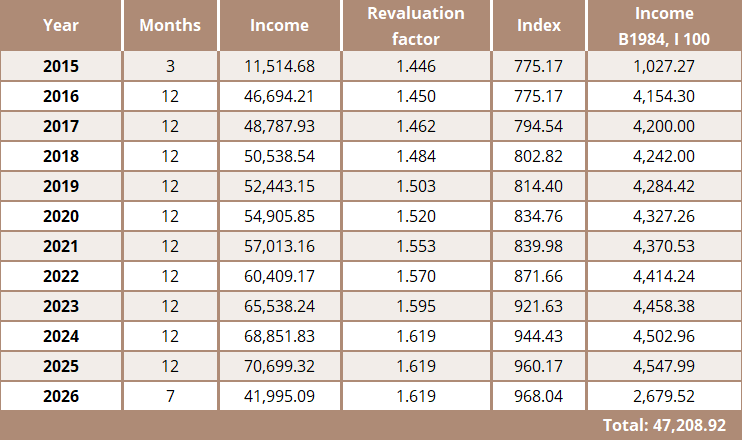
Beyond his months of compulsory insurance in Luxembourg, Jean-Louis’s insurance career shows 278 months of compulsory insurance in France.
On 1 August 2026, at the age of 51, Jean-Louis becomes invalid and begins receiving an invalidity pension from that date. To determine the amount of his pension, it is necessary to calculate the lump-sum increases as well as the proportional increases.
Due to his mixed career in several countries, in order to determine the level of Jean-Louis’s pension, two calculations are carried out: the national pension and the proportional pension. The higher of the two amounts is then paid to him.
The national pension
For the calculation of the national pension, the insurance periods completed under another pension scheme are completely disregarded.
The amount of Jean-Louis’s national pension, in base year 1984 and at index number 100, is calculated as follows:
- ‘Normal‘ lump-sum increases: Jean-Louis can demonstrate 130 months of insurance in Given that a commenced year counts as a full year for the ‘normal’ lump-sum increases, Jean-Louis is entitled to 11/40 of the lump-sum increases, i.e. 25.075% × 2,085 × 11/40 = 143.77 euros per year (in base year 1984 and at index 100).
- Special lump-sum increases: These depend on the number of years between the start of the invalidity pension entitlement and the completion of the age of 65, but also take into account that after the age of 24, Jean-Louis was not always insured in Luxembourg under pension insurance.
The period from the start of pension (01.08.2026) to the age of 65 (23.02.2040) for Jean-Louis extends over 13.58 years.
Given that since the calendar year following Jean-Louis’s 24th birthday (2000) until the start of the invalidity pension – i.e. over a period of 26.58 years – he was insured under the pension insurance scheme in Luxembourg for 10.83 years, Jean-Louis is only entitled to 10.83 / 26.58 = 40.8% of the prospective years under the special lump-sum increases.
Given that a year that has begun counts as a full year, Jean-Louis is therefore entitled to 6 (40.8% × 13.58 = 5.53 years) fortieths in respect of special lump-sum increases; he is therefore entitled to 25.075% of 2,085 × 6/40 = 78.42 euros per year (based on 1984 and index 100).
- ‘Normal‘ proportional increases: Due to his contributory income in Luxembourg, Jean-Louis is entitled to 1.763% × 47,208.92 = 29 euros per year in proportional increases.
- Special proportional increases are granted based on the number of years between the start of entitlement to a invalidity pension and reaching the age of 55, as well as the reference base.
For Jean-Louis, the reference base is 47,208.92 (the sum of all contributory income from the calendar year following his 24th birthday) divided by 26.58 (the number of years from the calendar year following his 24th birthday), i.e. 1,775.88 euros.
Given that the number of years between the start of Jean-Louis’s entitlement to a invalidity pension and his 55th birthday is 3.58 years (period from 01.08.2026 – 23.02.2030), the special proportional increases amount to:
1,775.88 × 3.58 × 1.763% = 112.09 euros per year (based on 1984 and index 100).
The annual national invalidity pension based on 1984 at index 100 therefore amounts to:
143.77 + 78.42 + 832.29 + 112.09 = 1,166.57 euros.
The proportional pension
For the calculation of the proportional pension, a theoretical pension calculation is first carried out, which would have been due if Jean-Louis had completed all the insurance periods, including those completed abroad, under his legislation. To determine this amount, the ratio between compulsory periods in Luxembourg and total com-pulsory periods is determinant.
For Jean-Louis, this ratio amounts to: 130 / (130 + 278) = 0.31863.
The theoretical invalidity pension of Jean-Louis, in base year 1984 and at index number 100, is calculated as follows:
- Theoretical ‘normal‘ lump-sum increases: Jean-Louis can demonstrate 408 months of insurance in Given that a commenced year counts as a full year for the normal lump-sum increases, Jean-Louis is entitled to 34/40 of the lump-sum increases, i.e. 25.075% × 2,085 × 34/40 = 444.39 euros per year (based on 1984 and index 100).
- Theoretical special lump-sum increases: These depend on the number of years between the start of the invalidity pension entitlement and the completion of the age of 65.
The period from the start of pension (01.08.2026) to the age of 65 (23.02.2040) for Jean-Louis extends over 13.58 years.
Given that from the calendar year following Jean-Louis’s 24th birthday (2000) until the start of his invalidity pension – i.e. over a period of 26.58 years – he was insured at all times under the pension insurance scheme (in Luxembourg or elsewhere), Jean-Louis is entitled to the full number of prospective years under the special lump-sum increases, without, however, the total number of years taken into account exceeding 40.
Jean-Louis is therefore entitled to 6 (40 – 34 already taken into account as ‘normal‘ increases) fortieths under the special lump-sum increases; he is therefore entitled to 25.075% of 2,085 × 6/40 = 78.42 euros per year (based on 1984 and index 100).
- Theoretical ‘normal‘ proportional increases: Due to his contributory income in Luxembourg, Jean-Louis is entitled to proportional increases equal to:
Rate of proportional increases × Total contributory income at index 100 and in the base year 1984 in Luxembourg / Ratio between compulsory periods in Luxembourg and total compulsory periods
= 1.763% × 47,208.92 / 0.31863
= 2,612.12 euros per year (based on 1984 and index 100).
- Special proportional increases are granted based on the number of years between the start of entitlement to invalidity pension and the completion of the age of 55, as well as the reference base.
For Jean-Louis, the reference base is 47,208.92 (the sum of all contributory income from the calendar year following his 24th birthday) divided by 26.58 (the number of years from the calendar year following his 24th birthday), i.e. 1,775.88 euros.
Given that the number of years between the start of Jean-Louis’s entitlement to a invalidity pension and the completion of his 55th birthday is 3.58 years (period from 01.08.2026 – 23.02.2030), the special proportional increases amount to:
Reference base × number of years between the start of entitlement to the invalidity pension and reaching the age of 55 × Rate of proportional increases / Ratio between compulsory periods in Luxembourg and total compulsory periods
= 1,775.88 × 3.58 × 1.763% / 0.31863
= 351.78 euros per year (based on 1984 and index 100).
The theoretical annual pension based on 1984 at index 100 therefore amounts to:
444.39 + 78.42 + 2,612.12 + 351.78 = 3,486.71 euros.
This theoretical pension must still be multiplied by the ratio between compulsory periods in Luxembourg and total compulsory periods in order to take into account the fact that Jean-Louis did not spend his entire professional career in Luxembourg.
The proportional annual pension based on 1984 at index 100 is therefore: 3,486.71 × 0.31863 = 1,110.96 euros.
As the national pension is higher than the proportional pension, it is this pension that is paid to Jean-Louis. This amount is higher than the minimum pension to which Jean-Louis would be entitled based on his mixed career.
To obtain the actual amount in 2026 and at the current index, it must be multiplied by the revaluation factor of 2022 and the current index:
1,166.57 × revaluation factor of 2022 × current index / 100
= 1,166.57 × 1.57 × 9.9224
= 18,173.00 euros per year, or 1,514.42 euros per month.
Added to this are the 11/40 of the end-of-year allowance, paid together with the December pension.
(last updated on 29 June 2026)
The cumulation of an invalidity pension with other income
Cumulation of an invalidity pension and professional income
When a beneficiary of an invalidity pension still exercises a professional activity, the income drawn from this activity may not exceed one third of the unskilled social minimum wage. If this income limit is exceeded, the insured person no longer fulfils the conditions for the invalidity pension and the pension is withdrawn, where applicable, retroactively.
(last updated on 29 June 2026)
Cumulation of an invalidity pension and an accident pension
In the event of the cumulation of an invalidity pension with an accident pension, the pension is reduced insofar as it exceeds, together with the accident pension:
- either the average of the 5 highest annual incomes of the insurance career, without this average being less than the reference amount increased by 20% (3,248.05 euros per month as at 1 June 2026);
- or the professional income which served as the basis for calculating the accident pension, if this other method of calculation is more favourable.
(last updated on 29 June 2026)