- CSL
- Who is the CSL?
- Missions and activities
- Structure
- Plenary assembly
- Members
- Commission
- Internal Commissions
- Commission on Economic Affairs, Taxation and Budgetary Policy
- Commission on Social Affairs, Health and Safety at Work and the Environment
- Commission on European and Interregional Affairs
- Commission on Vocational Training and Continuing Education
- Commission for crossborder work
- Commission for demographic ageing and its impact on society
- Equality Committee
- Finance Commission
- Commission on the situation of young people in the modern labour market
- Secretariat
- At a glance
- History
- Opinions
- Position papers
- Your rights
- Employees
- Types of employment
- Trial period
- Remuneration
- Definition of the term “remuneration”
- Wage level
- Collective bargaining agreement wage scales
- Salary supplements
- Premium payments
- Wage indexing
- Payment of wages
- Garnishment and assignment
- What is meant by wage garnishment?
- What part of a person’s salary can be garnished?
- Is garnishment carried out on gross or net pay?
- What happens if several garnishment actions are carried out on a single pay source?
- How is the garnishing of wages carried out in the case of a maintenance claim?
- What is the difference between a garnishment of earnings and an assignment of earnings?
- Deductions from wages
- Salary comparison
- Working time
- Basic principles
- Who is covered by the legal strictures on working time?
- Who is to be considered a senior manager?
- What is meant by working time?
- How many hours per day and per week can employees work?
- Can an employee have several jobs?
- How is the working week split into days?
- At what time must the employee report to work and what rest period is required during a shift?
- Is an employer entitled to unilaterally change the working hours of employees?
- Can an employer unilaterally change the distribution of weekly working hours over the days of the week?
- Are employers obliged to set up a system for recording working hours?
- Part-time work
- What is meant by part-time work?
- What special information is included in part-time employment contracts?
- Do employers have to offer part-time work to employees who request it?
- Can an employee refuse to work part-time?
- What are the rights of part-time employees?
- Part-time workers and the work organisation plan (WOP): what conditions must be fulfilled?
- Can an employer force a part-time employee to work overtime?
- Minimum rest period
- Overtime
- Sunday work
- Night work
- Work on public holiday
- What employees are involved?
- Which days qualify as legal holidays?
- What happens when a legal holiday occurs on a Sunday?
- What happens when a legal holiday occurs on a working day that has been declared a “working day not worked”?
- What happens when a legal holiday occurs on a working day?
- If a public holiday falls during a period when the employee is off sick, can compensatory leave be awarded later?
- How is work on legal holidays paid?
- How is work on a public holiday that is also a Sunday paid?
- How is work on legal holidays paid in companies working on a seasonal basis?
- What about young workers who work on a legal holiday?
- Are employers required to keep a separate register for holiday work?
- Flexible working time arrangements
- What is meant by flexible working time arrangements?
- What is meant by work organisation plans (WOP)?
- What about overtime in a WOP?
- What are the rules protecting night workers under a WOP?
- What are the rules protecting part-time workers under a WOP?
- What are the rules protecting young workers that form part of the WOP?
- How long can a reference period last?
- What is flexitime?
- Young people
- What are young workers?
- What is meant by working time for young workers?
- What are the limits to working time applicable to young workers?
- What are the young worker's rest periods?
- Can young workers work overtime?
- Can young workers work at night?
- Can young workers work on Sundays or legal holidays?
- Can the working hours of young workers be made flexible?
- Pregnancies
- Time savings account (CET)
- How are time savings accounts set up?
- When was this introduced into the Labour Code?
- How are contributions to a time savings account made?
- How does one use a time savings account?
- How are employees protected?
- How is a time savings account liquidated?
- What are an employer’s obligations?
- What guarantees are in place in case of employer bankruptcy?
- What about current collective bargaining wage scales?
- What is the task of the staff delegation with regard to the time savings account?
- What is the impact of a time-saving account on unemployment benefits?
- What is the tax treatment of time savings accounts?
- Flexible working arrangements
- What are the qualifying conditions?
- What are "flexible working arrangements"?
- How can the employer respond?
- How is the return to the original working arrangement organised?
- Is the employee protected against dismissal?
- Are the employment and the rights attached to it to be maintained?
- Can an employee be subject to reprisals or less favourable treatment?
- What are the penalties for non-compliance?
- CSL publication
- Basic principles
- Changes in working conditions
- Statutory leaves
- Overview
- Annual recreation leave
- Extraordinary leave
- What family event qualifies for extraordinary leave?
- When is an employee entitled to leave for reasons of force majeure?
- How long is the leave for reasons of force majeure?
- What is the caregiver leave?
- How long is caregiver leave?
- What should an employee do if he intends to take leave for reasons of force majeure or carergiver leave?
- Can extraordinary leave be carried over?
- Can a newly hired employee take extraordinary leave without waiting for the three-month period to expire?
- How many times can extraordinary leave for moving house be taken?
- Can extraordinary leave be awarded if the family event occurs during a period of illness?
- If an event occurs during a period of regular leave, is extraordinary leave due?
- Who pays for the extraordinary leave?
- What are the terms and conditions for taking the 10-day leave for the birth or adoption of a child?
- Are part-time employees entitled to the same number of special leave days?
- How can employees in a civil union get extraordinary leave?
- Are employees in a union under foreign law eligible for extraordinary leave?
- How are employees protected during extraordinary leave?
- Family-related leave
- Training-related leave
- Sports leave
- What is the purpose of sports leave?
- Who is entitled to sports leave?
- What are the conditions for taking sports leave?
- How long does sports leave last?
- Does sports leave count as working time?
- Can sports leave be split?
- Can the duration of sports leave be prorated?
- Is the sports leave cumulative?
- Can sports leave be postponed from one year to the next?
- How do I apply for sports leave?
- Can the employer refuse sports leave?
- How is sports leave paid?
- Leave related to an employee’s status as an elected official
- Development cooperation leave
- What is the purpose of development cooperation leave?
- Who is eligible for development cooperation leave?
- Which type of missions are eligible for development cooperation leave?
- What process should be followed to obtain development cooperation leave?
- How long is development cooperation leave?
- Is development cooperation leave considered as actual working time?
- Special leave for volunteer firefighters
- What is the purpose of special leave for volunteer firefighters?
- Who is eligible for this type of leave?
- What training activities are eligible?
- How much time off do volunteer firefighters get?
- Who should volunteer firefighters apply to for leave?
- Can employers object to the leave?
- Is the leave for relief volunteers considered as a period of actual work?
- Who pays for special leave for volunteer firefighters?
- Leave to seek new employment
- CSL Publication
- Illness
- Obligations of the employee
- Employer’s obligations
- Termination of contract due to illness
- Health assessments
- Leave entitlement
- Progressive return to work for therapeutic reasons
- What is meant by a progressive return to work for therapeutic reasons?
- How does one apply for a gradual return to work for therapeutic reasons?
- Do I need the employer's consent?
- What are the consequences for the employee?
- Do employees who are progressively returning to work get their entire statutory leave?
- Reclassification
- What does the Social Security Medical Board (CMSS) do with a long-term sick employee?
- What happens if CMSS considers the employee fit for work?
- What happens if CMSS considers that the illness is lasting?
- What happens if the CMSS discovers a disability?
- What happens if CMSS recommends internal or external reclassification?
- Am I protected against dismissal?
- Can I be internally reclassified?
- Can I be reclassified externally?
- CSL publication
- Workplace monitoring
- Which people are protected by law?
- What is meant by personal data?
- What is meant by processing of personal data?
- Who is responsible for the data processing when it is carried out?
- What rules and conditions must be complied with by anyone who intends to set up a personal data processing system?
- When can personal data be processed?
- Under what conditions can an employer process personal data for surveillance purposes in the workplace?
- What are the rights of the person whose data is processed?
- CSL Publication
- Posting of employees
- What is a posted employee?
- To whom do the posting rules apply?
- Under what conditions is a posting possible?
- When can a posting be made?
- What about posting for temporary work agencies or companies that post their employees as a temporary loan of labour?
- What about doubts as to the reality of a posting or as to whether a company carries out a real and substantial economic activity in its country of origin?
- What are the rights of a posted employee?
- What is the maximum duration of a posting?
- What about initial assembly or first-time installation work?
- What about expenses related to the posting?
- What is the process for posting an employee to Luxembourg?
- What are the obligations of the principal or the client?
- What are the obligations of a client with regard to temporary work or the temporary loan of labour?
- What are the accommodation conditions for an employee who is away from his usual place of work?
- Which national authority controls the application of the posting rules?
- What penalties exist in the area of posting?
- End of employment contracts
- Dismissal
- Resignation
- In what form should a resignation be submitted to an employer?
- Must an employer be informed of the reason for a resignation?
- What is the notice period for resignation?
- What is the starting point of the notice period?
- What is the penalty if an employee fails to comply with the notice period?
- Can the notice period be offset against the employee's remaining leave?
- Can a person be exempted from serving a notice period following a resignation?
- In what cases can a person resign without notice?
- Si je démissionne, est-ce que j’ai droit à des indemnités ?
- Legal action for wrongful dismissal
- Imprisonment
- Automatic termination of employment contract
- Certificate of employment
- Does the employer have to issue a work certificate at the end of the employment contract?
- Does an employment certificate have to be issued for an employee with a fixed-term employment contract?
- What if the employer refuses to issue a work certificate despite the employee's request?
- What should an employment certificate contain?
- What to do if the certificate contains unfavourable statements?
- Non-competition clause
- What is a non-competition clause?
- Can an employer prohibit an employee from being poached by a competitor?
- Can a non-competition clause result from a verbal agreement between the employer and the employee?
- Under what conditions is a non-competition clause valid?
- Can a non-competition clause be added to an employment contract during its term?
- Business ownership transfer
- What is meant by a business transfer?
- What is meant by a transferor?
- What is a transferee?
- To whom do the rules on the employment of employees apply in the event of a business transfer?
- What happens to employees' employment contracts when ownership of a business is transferred?
- What about the transferor and transferee's liability?
- What are the obligations of the transferor and the transferee?
- What about the collective rights of employees in the event of a company transfer?
- Can the transfer of a business be a reason for dismissal?
- What obligations do the transferor and the transferee have with regard to providing information and consultations?
- What is the impact of the transfer on the status of employee representatives?
- Unemployment compensation
- Who can be compensated for the loss of a job?
- How can a person receive unemployment benefits?
- How long can the unemployed person receive benefits?
- Are unemployment benefits payable if I lose my part-time job?
- Are employees who are ill at the end of their notice periods entitled to unemployment benefits?
- How much are unemployment benefits?
- Are unemployment benefits reduced if an unemployed person earns money intermittently?
- When do unemployment benefits end?
- Legal action before the Labour Tribunal
- Health & safety in the workplace
- Employees concerned
- Responsible players
- Occupational Health Services
- Pre-employment medical examination
- Are employees required to undergo a pre-employment medical examination?
- What is the purpose of the pre-hiring medical examination?
- In what cases are employees subject to periodic medical examinations?
- What is an at-risk position?
- What if an employee has been declared fit for work?
- What if an employee has been declared unfit for work?
- Place of work
- Illness
- Reclassification
- What does the Social Security Medical Board (CMSS) do with a long-term sick employee?
- What happens if CMSS considers the employee fit for work?
- What happens if CMSS considers that the illness is lasting?
- What happens if the CMSS discovers a disability?
- What happens if CMSS recommends internal or external reclassification?
- Am I protected against dismissal?
- Can I be internally reclassified?
- Can I be reclassified externally?
- CSL publication
- Occupational accidents and diseases
- Pregnant women, young people and disabled workers
- Harassment
- Discrimination
- Alcohol, drug abuse, smoking
- Social dialogue
- Staff representation
- Setting up staff delegations
- Composition of the staff delegation
- Appointment of the staff delegation
- Duration and end of the mandate
- Remit of the staff delegation
- Health and Safety Representative
- Equal Opportunity Officer
- Resources available to the staff delegation
- Organization and functioning
- Status of employee delegates
- Litigation
- Délégation au niveau de l’entité économique et sociale
- Employee representatives in limited companies
- Collective labour agreements
- National Conciliation Office (ONC)
- Negotiation of a collective labour agreement
- Parties to the collective agreement
- Agreements on inter-professional social dialogue
- Observatoire des relations professionnelles et de l’emploi (ORPE)
- Arbitration
- Content of the collective labour agreement
- Signature and entry into force of the collective agreement
- Staff representation
- Third country nationals
- Definitions
- Stay of less than three months
- Stay of more than three months
- Residence permit for highly skilled employment
- Work permits for seasonal workers
- Residence and work permit for self-employed persons and investors
- Residence permits for athletes
- Residence permit for students, pupils, trainees, volunteers or au pairs
- Residence permit for researchers
- Family reunification
- International protection
- Frontier workers
- Youth
- Permanent employment contract (CDI)
- Employing school pupils and students on fixed-term contracts (CDD)
- What are the features of this type of employment?
- Who can benefit from this arrangement?
- What is the maximum working time?
- What is the maximum duration of the contract?
- Is it necessary to enter into a contract?
- What should the contract say?
- How much is the pupil’s/student’s pay in such a fixed-term contract (CDD)?
- Does the pupil/student need to be registered for social security?
- Does the pupil or student have to pay tax?
- Is the pupil/student entitled to state financial assistance for higher education?
- Is the pupil/student entitled to days off and statutory holidays?
- Do trainees who are minors enjoy special protection by virtue of their age?
- Can the contract be terminated before it expires?
- Who supervises the employment of pupils and students outside the school holidays?
- Which court has jurisdiction in case of disputes?
- Initial professional training
- Public school system
- Professional training courses
- Which vocational courses include internships?
- How do I find an internship position?
- Do I have to sign an internship agreement?
- What should the student intern commit to?
- What does the training organization have to commit to?
- What are the responsibilities of tutors in the school and professional environment?
- How is the placement course evaluated?
- What is the daily attendance time of student trainees in the training organization?
- Do student trainees get school holidays and vacations?
- Do student trainees receive compensation during the internship?
- What should the student trainee do in case of illness or absence?
- Are student trainees insured against accidents?
- What other protective provisions apply to student trainees?
- What happens if the course is interrupted?
- Can the internship agreement be interrupted?
- Useful information
- Employing school pupils and college students during academic holidays
- What are the features of this type of employment?
- Who can work as a pupil or student during academic vacations?
- Is there a maximum employment time?
- Is it necessary to enter into a contract?
- What should the contract say?
- How much is the pupil's/student's remuneration?
- Do pupils/students have to pay taxes?
- Is the pupil/student entitled to state financial assistance for higher education?
- Does the pupil/student need to be registered for social security?
- Is the pupil/student entitled to time off?
- Do pupils/students benefit from special protection?
- Can the contract be terminated before it expires?
- Who supervises the employment of pupils/students?
- Which court has jurisdiction in case of disputes?
- Internship
- Employment support contract (CAE)
- Who is eligible?
- How to find an available position?
- How is the contract concluded?
- How long does it last?
- How long does the young person work?
- How is the young person supervised?
- How is a young person evaluated?
- What is the young person's remuneration?
- What are the common law rules that apply?
- What are the young person's obligations?
- What assistance is available to the employer?
- How is the employer encouraged to hire the young person at the end of the contract?
- How does the contract end?
- CSL Publication and Case law
- Employment initiation contract (CIE)
- Who is eligible?
- How to find an available position?
- How is the contract concluded?
- How long does it last?
- How long does the young person work?
- How are young persons supervised?
- How is the young person evaluated?
- What is the young person's remuneration?
- What are the common law rules that apply?
- What assistance is available to the employer?
- How is the employer encouraged to hire the young person at the end of the contract?
- How does the contract end?
- What are the employer's obligations at the end of the contract?
- CSL Publication and Case law
- Working time
- What are young workers?
- What is meant by working time for young workers?
- What are the limits to working time applicable to young workers?
- What are the young worker's rest periods?
- Can young workers work overtime?
- Can young workers work at night?
- Can young workers work on Sundays or legal holidays?
- Can the working hours of young workers be made flexible?
- Social security
- Accidents
- Dependency
- Pensions
- General provisions
- Historical overview of the general pension insurance scheme
- The different pension schemes in Luxembourg
- The functioning of the general pension insurance scheme
- The affiliation to the general pension insurance scheme
- The financing of the general pension insurance scheme
- The deductions on pensions and social security affiliation
- The reimbursement of contributions
- The appeal procedures
- Old-age pension
- Invalidity pension
- Survivor’s pension
- Estimating your pension
- Important questions – easily explained
- I am preparing my pension application...
- I have children...
- I work part-time
- I want my studies to be recognised for pension purposes...
- I wish to insure myself / pay contributions on a voluntary basis...
- I am interested in the purchase of periods...
- I have worked in several countries...
- The date if entitlement to the pension...
- The amount of my pension...
- I receive a pension and I continue to work...
- I receive a pension and I live abroad...
- I have become invalid...
- Regarding the survivor's pension...
- Useful information
- General provisions
- Aid
- Unemployment
- Family benefits
- What are the main amounts related to family benefits?
- The Children's Future Fund
- What are the different types of family benefits?
- What are the steps to obtain the benefits?
- What about payment of benefits?
- How are family benefits organised in the EU?
- What about the prescription of benefits?
- What about the assignment, pledging and seizure of benefits?
- What about undue benefits?
- What about penal provisions?
- Useful information
- CSL Publication
- REVIS
- What is a Social Inclusion Income (REVIS)?
- Who can benefit from REVIS?
- How is the REVIS calculated?
- Under what circumstances should the inclusion allowance be returned?
- How do I apply for a REVIS?
- What transitional provisions apply to recipients of the RMG?
- What are the remedies?
- What other public aid is available?
- Useful informations
- CSL Publication
- Housing
- Educational bursaries
- How has the graduate financial aid system evolved in recent years?
- What is new with the 29 October 2019 law?
- Who is eligible for state student financial aid?
- What financial aid is available to students?
- For how many semesters can a student receive financial aid?
- What steps must a student take to receive graduate financial aid?
- What documents should be submitted with an application for financial aid?
- What appeals of a decision to refuse financial aid are possible?
- Payroll taxation
- Legal library
- Employees
- Health, well-being and security at work
- Quality of Work Index Luxembourg
- Stressberodung
- Preventing psychosocial risks
- Your rights: Health & safety in the workplace
- Awareness campaign “Prevention of health risks in the workplace”
- Newsletter
- Initial professional training
- Presentation
- Public school system
- Apprenticeship
- Ready for an apprenticeship? Here's how to get started...
- What are the advantages of a vocational training under an apprenticeship contract?
- How does a typical apprenticeship training program work?
- Which trades / professions are organized under an apprenticeship contract?
- What are the rights and obligations of an apprentice?
- Who should the apprentice talk to during their apprenticeship?
- What about adult education?
- What about cross-border learning?
- What about apprenticeship benefits?
- Professional training courses
- Which vocational courses include internships?
- How do I find an internship position?
- Do I have to sign an internship agreement?
- What should the student intern commit to?
- What does the training organization have to commit to?
- What are the responsibilities of tutors in the school and professional environment?
- How is the placement course evaluated?
- What is the daily attendance time of student trainees in the training organization?
- Do student trainees get school holidays and vacations?
- Do student trainees receive compensation during the internship?
- What should the student trainee do in case of illness or absence?
- Are student trainees insured against accidents?
- What other protective provisions apply to student trainees?
- What happens if the course is interrupted?
- Can the internship agreement be interrupted?
- Useful information
- Economic pages
- Events
- Library
- 100 years CSL
The pension application and its payment
Preliminary steps before the pension application
From the age of 55, insured persons have the possibility of submitting a request for an estimate of the old-age or early old-age pension. It is strongly advised that insured persons make use of this possibility, which entails undeniable advantages for the insured persons.
First of all, the request provides the insured person with an estimate of the amount of their future pension which takes into account the extension of their career – enabling them to better anticipate their future income. Although at the age of 55, the insured person’s annual career statement already contains the mention of a pension level, it must be noted that this represents the pension acquired up to 1 January of that year and that this figure takes into account neither the years to come before the pension departure, nor any career completed abroad.
Furthermore, it should be added that, within the framework of this estimation request, the insured person has the possibility of obtaining this pension estimate ‘at the earliest possible date’, so that the insured person will be informed of the first date from which they may claim their pension entitlements. This date may guide the insured person in deciding the moment to submit the early old-age pension application.
Finally, given that the pension estimation request is made on the basis of the same data as the future effective pension calculation, and that the National Pension Insurance Fund (CNAP – Caisse nationale d’assurance pension) collects the same data as at the time of the effective pension application, the estimation request procedure makes it possible to clarify a number of questions prior to the pension application. All the additional information required, whether information on the career abroad or the consideration of non-contributory periods, may be collected at that time by the CNAP. Thus, the estimation request enables the insured person’s ‘pension‘ file to be virtually finalised, at a time when they are not yet about to retire – ensuring that the future procedure for processing the pension application is accelerated.
(last updated on 15.07.2026)
The timing of the pension application
It is important to note that all social security benefits, including old-age pensions, are only granted upon formal application by the interested parties. Thus, even though the Labour Code provides for the automatic termination of the employment contract at the age of 65, the insured person must still submit a pension application in order to avoid finding themselves without income after the automatic termination.
The duration of the processing of pension applications depends on the availability and reliability of the underlying data and may therefore vary considerably from one application to another. If, for example, the collection of data involves complex research abroad, the processing may take months.
In order to avoid delays relative to the retirement date, it is advisable to submit the old-age or early old-age pension application, accompanied by the supporting documents, several months before the date of the opening of the entitlement with the CNAP. Whilst periods of between three and six months are generally sufficient for purely Luxembourg careers, for migratory careers it is preferable to submit the pension application between six and nine months before the pension start date. In the case of a prior pension estimation request, the processing times may be reduced considerably.
Once the processing is complete, the pension is granted or rejected by a decision subject to appeal. (See ‘ The appeal procedures’)
The Labour Code provides that in the event of retirement on an old-age pension, the employment contract ceases as of right. To this end, it is sufficient for the employee to inform their employer of their retirement once their application has been accepted. No resignation and no notice period are provided for this notification.
(last updated on 15.07.2026)
The competent pension fund
Even if the insured person has worked in several countries, it is sufficient to submit the pension application in one country only – provided that the countries in which they were insured are either countries of the European Free Trade Association (EFTA, comprising the countries of the European Union, Switzerland, Liechtenstein, Iceland and Norway), or countries with which Luxembourg has a bi- or multilateral agreement in the field of social security.
The pension application is generally submitted to the pension fund either of the last country in which the employee was insured under pension insurance, or of the country of residence. Where the pension application refers to a mixed career in several countries, the pension fund takes charge of the transfer of liaison forms to the competent bodies of the other countries concerned.
The date of submission of the application is valid with regard to all the institutions concerned.
(last updated on 15.07.2026)
The payment of the pension
Three scenarios may arise:
- If the insured person has contributed for less than one year in the Grand Duchy of Luxembourg and the remainder of their career in another country, it is the pension fund of that country that pays their pension in full;
- If the insured person has completed part of their professional career in Luxembourg and the other part in another EU or EFTA country, this is referred to as a mixed career: the worker receives a pension from each State, provided that they were insured in the country for at least one year;
- If the insured person has completed their entire professional career in the Grand Duchy, their entire pension is paid by the Luxembourg pension fund, even if they do not reside in the country.
Old-age pensions are paid monthly in advance by means of a bank transfer to a bank account of the beneficiary. The pension ceases to be paid at the end of the month in which the beneficiary dies. Any monthly instalments paid in excess for months subsequent to the death must be reimbursed.
(last updated on 15.07.2026)
The conditions for entitlement
The statutory old-age pension
The statutory old-age pension refers to any old-age pension paid from the statutory pension age – namely from the age
of 65.
Any insured person who can demonstrate a total qualifying period of at least 120 months under compulsory insurance, continued insurance, optional insurance or retroactive purchase of periods is entitled to a statutory old-age pension at the age of 65.
ATTENTION: The entitlement to the statutory pension in Luxembourg is not subject to the condition that the 10 years of contribution periods have been completed in Luxembourg. Indeed, an insured person who can demonstrate 10 years in total, in Luxembourg and abroad, without completing 10 full years in Luxembourg, may be entitled to a Luxembourg pension by virtue of the principle of the aggregation of insurance periods. (See ‘The aggregation of periods’)
(last updated on 15.07.2026)
Early old-age pension
Luxembourg legislation provides that it is possible to take an old-age pension before the statutory age of 65. In this case, one always refers to an early old-age pension.
An insured person who can demonstrate 480 months of compulsory insurance periods is entitled to an early old-age pension from the age of 57.
Without demonstrating 480 months of compulsory insurance periods, an insured person is entitled to an early old-age pension from the age of 60 if they 1) can demonstrate 480 months of compulsory insurance periods, continued insurance periods, optional insurance periods, retroactive purchase periods or additional periods, of which at least 120 months of compulsory insurance periods, continued insurance periods, optional insurance periods or retroactive purchase periods; and 2) if, after fulfilling the dual condition of age and qualifying period, they extend their insurance career:
- by at least 1 month if they retire from July 2026 onwards;
- by at least 2 months if they retire in 2027;
- by at least 4 months if they retire in 2028;
- by at least 6 months if they retire in 2029;
- by at least 8 months if they retire from 2030 onwards.
The months of career extension must correspond to periods of compulsory insurance, continued insurance or optional insurance.
This condition of career extension for early old-age pensions for insured persons not demonstrating 480 months of compulsory insurance periods was introduced by the law of 19 December 2025.
The career extension is not required for insured persons in early retirement due to company restructuring or in early retirement for shift workers and night workers, nor for employees benefiting from progressive early retirement before July 2026.
EXAMPLE 1
Jean-Yves was born on 14 March 1969 and started working on 21 July 1988 at the age of 19.
Provided that since that age Jean-Yves was always insured on a compulsory basis (work, compensated unemployment, parental leave, etc.), he will be able, as in the past, to take his early old-age pension on 21 July 2028 at the age of 59 after 40 years of compulsory insurance periods.
EXAMPLE 2
Marie-Sophie was born on 27 May 1969. After a period of studies until the age of 22, she began working on 4 September 1991. Until the age of 60, she is insured at all times, either on a compulsory basis (work, compensated unemployment, parental leave, etc.), or on a voluntary basis, or under additional periods (child-raising periods, for example).
Before the 2025 reform, such a career would have allowed Marie-Sophie to take early old-age pension on 27 May 2029 at the age of 60 – due to the fact that she demonstrates, including study periods, at least 40 years of insurance career.
However, the 2025 reform obliges Marie-Sophie to extend her insurance career by 6 months – either through months of work or through months of voluntary insurance. She could therefore take early old-age pension at the earliest at the age of 60 years and 6 months, i.e. on 27 November 2029.
At the age of 65, all early old-age pensions are automatically converted into statutory old-age pensions.
THEMATIC BOX II: EARLY RETIREMENT
The early old-age pension is frequently confused with early retirement. Not only because of the semantic proximity of the two terms, but also because of the lowering to 57 years of the minimum age giving entitlement to the early old-age pension – an age also corresponding to that at which access to early retirement may be granted under certain conditions.
However, there is a fundamental difference between these two mechanisms. The old-age pension before 65 falls under pension insurance, while early retirement, the duration of which is limited to three years, constitutes notably an instrument for the prevention of unemployment and is treated as years of compulsory insurance which are taken into account for the old-age pension.
There are three types of early retirement:
- Early retirement due to company restructuring: Under an agreement with the Ministry of Labour, employers may request that their staff be admitted to early retirement due to company restructuring in the event of company closure or to avoid redundancies resulting from job losses caused by company restructuring or job changes due to technological change.
- Early retirement for shift workers and night workers: Upon written request to their employer, employees may be granted early retirement if they can prove that, during their professional career, they have worked shifts including night shifts for at least 20 years, provided that night work has accounted for at least 20% of the normal monthly working time, or fixed night work for at least 20 years where night work represented at least 50% of normal monthly working time. Furthermore, eligibility for early retirement may also be recognised if, over the last 25 years, the employee has worked shifts including night shifts for 15 years, with a minimum of 20% of normal monthly working time, or fixed night shifts for 15 years, with at least 50% of normal monthly working ‘Night work’ is defined as any period of activity between 10 p.m. and 6 a.m.
- Progressive early retirement: Progressive early retirement is granted to employees of eligible companies under an express provision of a collective bargaining agreement or under a special agreement concluded between the Minister of Labour and a specific company. The part-time working hours of employees eligible for progressive early retirement, as set out in an amendment, must be at least 40% and no more than 60% of their previous working hours.
In addition to the specific conditions of each early retirement scheme, common rules and restrictions apply to all schemes. Thus, early retirement, regardless of type, cannot be granted before the age of 57. Furthermore, to be eligible for early retirement, employees must be able to meet the conditions for accessing the statutory old-age pension or early old-age pension no later than 3 years after entering early retirement. The maximum duration of early retirement benefits is limited to 3 years.
The principle also stipulates that early retirement ends when the insured person reaches the age of 63. However, while respecting the 3-year limit, early retirement may be extended until the age of 65 for employees who are not entitled to an early old-age pension or, in the case of early retirement due to company restructuring, if the amount of the early old-age pension to which employees would be entitled does not exceed the minimum pension.
Furthermore, in order to be eligible for early retirement, employees must have a minimum of five years’ seniority within the company submitting the application to the Ministry of Labour. Access to progressive early retirement is also subject to the condition that, during this five-year period, the position held corresponds to a working time of at least 75% of a full-time job.
The monthly early retirement allowance paid to employees eligible for early retirement is equal to 85% of their salary for the 12 months immediately preceding early retirement during the first year of compensation, 80% of this base during the second year and 75% during the remaining period.
Note that, as early retirement compensation is a second income subject to income tax withholding, taxpayers will need an additional tax card.
EXAMPLE
An employee applies for progressive early retirement by reducing his working hours by 50%. Over the last 12 months, he has earned a gross monthly salary of 5,000 euros. In addition, he received an average bonus of 6,000 euros a year during the three years prior to taking early retirement.
During his early retirement, the employee continues to receive 50% of his normal salary, including any bonuses. In addition, he receives early retirement compensation for the 50% reduction in working hours.
The early retirement benefit is calculated as follows:
Average monthly salary during the 12 months increased by the average bonus received during the three years preceding admission to early retirement:
(12 × 5,000 + 6,000)/12 = 66,000 / 12 = 5,500
Early retirement benfit:
-
- During the first year: 85% × 5,500 × 50% = 2,337.50
- During the second year: 80% × 5,500 × 50% = 2,200.00
- During the third year: 75% × 5,500 × 50% = 2,062.50
In addition, of course, there is the portion of the salary to which the employee is entitled due to their part-time work.
(last updated on 15.07.2026)
The different types of insurance periods
In order to determine the moment of the opening of the entitlement to the pension, but also for affiliation purposes, a distinction is made between different types of pension insurance periods.
Compulsory periods
Compulsory insurance periods correspond to periods during which persons are subject as of right to pension insurance, notably when they exercise a professional activity, salaried or self-employed, against remuneration.
These are mainly periods during which contributions are compulsorily levied on the insured person’s remuneration.
These periods are taken into account both for the opening of the entitlement to a pension and for the calculation of its amount.
According to the Social Security Code, the following constitute compulsory insurance periods:
- periods corresponding to a salaried professional activity;
- periods corresponding to a non-salaried professional activity;
- periods for which a replacement income is paid on which a contribution deduction under pension insurance is provided (sickness benefits, maternity benefits, accident benefits, unemployment benefits, early retirement benefits);
- periods corresponding to periods of activity exercised by members of religious associations and persons assimilable to them, in the interest of the sick and of public utility;
- periods corresponding, under a practical apprenticeship, to compensated vocational training periods, provided that they are situated after the age of 15 completed;
- periods accomplished by the spouse or partner and, for agricultural activities, by the relatives and relatives by marriage up to and including the 3rd degree of an insured person under a non-salaried professional activity, provided that the spouse or partner, the relative or relative by marriage is aged at least 18 years and renders to the said insured person services necessary to such an extent that these services may be considered as a main activity;
- upon request, a period of 24 months or 48 months on behalf of parents devoting themselves in Luxembourg to the education of one or more children (baby-years);
- periods accomplished in a developing country under development cooperation;
- war periods for victims of illegal acts of the occupier;
- periods of compulsory military service accomplished in the Luxembourg army;
- periods during which the interested party participated in a peacekeeping operation within the framework of international organisations;
- periods during which the interested party was a volunteer in the service of the army;
- periods during which a person provided assistance and care to a dependent person, without this constituting a professional activity;
- periods during which a person took in a child in day and night placement or in day placement and this placement was carried out by an approved body in accordance with the legislation governing the relations between the State and bodies operating in the social, family and therapeutic fields;
- periods during which the interested party participated in a volunteering activity;
- periods corresponding to parental leave from which the insured person has benefited;
- periods during which the interested party had an elite sporting activity recognised by the Luxembourg Olympic and Sporting Committee;
- periods of employment of disabled workers in a sheltered workshop from 1 June 2004 onwards;
- periods during which a person has received the inclusion allowance as part of the social inclusion income (REVIS), subject to prior affiliation to compulsory insurance for 25 years;
- periods during which a person has received income for severely disabled persons (RPGH), subject to prior affiliation to compulsory insurance for 25 years.
THEMATIC BOX III: THE BABY-YEARS
Baby-years are periods of compulsory insurance that may be granted to parents who are raising a child. The granting of baby-years is subject to the prerequisite that, during the 36 months preceding the birth of the child giving rise to entitlement to this scheme, the insured person must provide proof of at least 12 months of compulsory insurance. In addition, the period for which baby-years are taken into account must not overlap with a period of insurance covered by a foreign scheme.
In principle, baby-years cover a period of twenty-four months immediately following the birth or adoption of a child or, where applicable, following maternity leave. This period may be extended to 48 months if the child has a disability or if, at the time of its birth, two other children are already being raised in the household.
Parents designate the beneficiary of the insurance period or, where applicable, decide to share the period by means of a joint application. This decision cannot be changed. In the absence of an agreement between the parents and in the absence of proof provided by the parent making the application that they were solely responsible for the child’s upbringing, the period is shared equally between the two parents.
The purpose of baby-years is twofold: on the one hand, to recognise a period of insurance (monthly component) and, on the other hand, to take into account a notional income (monetary component).
The monthly element allows the 24-month period following the birth of a child to be validated as a compulsory insurance period when the insured person has ceased their professional activity. It thus ensures that any career break has no impact on the determination of when entitlement to an old-age pension or early old-age pension begins.
The financial element consists of attributing a notional contributory income for the baby-years period, regardless of whether or not the insured person has reduced their professional activity. This notional income corresponds to the average contributory income for the twelve months preceding the birth of the child, less the actual income received during the baby-years, but may not be less than 270.28 euros per month per child at index 100 and in the base year 1984. At the current index and revaluation factor, this amount is 4,341.88 euros per month per child. Where applicable, it is added to the actual income received by the insured person during this period and is taken into account when calculating the pension amount. (See ‘The calculation of the old-age pension’)
Thus, insured persons who completely interrupt their activity benefit from both the monthly element and the monetary element, while those who continue their professional activity retain only the advantage linked to the monetary element.
Specific rules apply in the case of closely spaced or multiple births. When the birth of a new child occurs during the period already covered by the baby-years, the periods apply simultaneously, but cannot be extended beyond the second birthday of the child concerned. In this case, two notional incomes may be taken into account and combined, one for each child entitling the parent to baby-years. Similarly, in the case of twins, the period remains limited to two years, but two separate notional incomes are credited for each child, which may be combined with actual income received.
The application for the inclusion of baby-years 49 may be submitted as soon as the child reaches the age of 4 and no later than the date of submission of the personal pension application. Even if the baby-years periods are recorded in the career statement as soon as the application has been accepted, final validation of the period only takes place at the time of the pension application.
EXAMPLE 1
Marie-Ange worked continuously with a gross salary of 3,000 euros before the birth of her child on 14 May 2024. After the birth of her child, Marie-Ange still has 12 weeks of maternity leave (until 6 August 2024), followed by six months of full-time parental leave (until 6 February 2025). Marie-Ange then ceases her professional activity.
In order to determine Marie-Ange’s insurance career, the periods from the birth of the child are taken into account as follows:
-
- 14.05.2024 – 05.08.2024: compulsory periods validated as maternity leave
- 06.08.2024 – 05.02.2025: compulsory periods validated as parental leave
- 06.02.2025 – 05.08.2026 (= two years after the end of maternity leave): compulsory periods validated as baby-years
Marie-Ange therefore has the option of remaining unemployed until 5 August 2026 without this having any impact on the moment of her pension entitlement.
To calculate her notional income for the baby-years, the average income for the twelve months prior to the birth minus her actual income, is taken into account,but this amount cannot be less than 4,341.88 euros. In Marie-Ange’s case, it is this latter amount that is taken into account, as her average salary was only 3,000 euros.
For the future calculation of her pension, the following income is taken into account from the birth of the child:
-
- 14.05.2024 – 05.08.2024: 3,000 euros/month as maternity pay
- 06.08.2024 – 05.02.2025: 3,000 euros/month as parental leave allowance + 4,341.88 euros/month as notional income due to baby-years
- 06.02.2025 – 05.08.2026: 4,341.88 euros/month as notional income due to baby-years
EXAMPLE 2
Jean-Jacques and Marie-Hélène had a child on 23 November 2024. Before the child was born, Jean-Jacques earned 5,000 euros and Marie-Hélène earned 6,000 euros gross per month. Both parents decided to share the baby-years, with Marie-Hélène taking the first parental leave.
Since neither parent took a break from work, the baby-years have no impact in terms of insurance months: the parents are affiliated through their work and do not need to take the baby-years into account to complete their insurance career.
However, in terms of income taken into account for the calculation of their pension, the baby-years are very useful:
-
- For Jean-Jacques, in addition to his income of 5,000 euros, which he continues to receive and on the basis of which he continues to contribute, a notional income of 4,341.88 euros is taken into account for the period from 23 November 2024 to 22 November 2025. The 12 months during which Jean-Jacques benefits from baby-years will therefore be considered for the calculation of his pension as if he had a contributory income of 9,341.88 euros.
- For Marie-Hélène, in addition to her income of 4,618.88 euros during parental leave (which is capped at this level) and her subsequent income of 6,000 euros, an additional notional income is taken into account for the period from 15 February 2025 (= end of maternity leave) to 14 February 2026 – an additional notional income corresponding to 4,341.88 euros, as this minimum is higher than 6,000 – 4,618.88 and 6,000 – 6,000 respectively.
EXAMPLE 3
Marie-Lise earns an average monthly salary of 5,000 euros. She gives birth to her first child on 27 July 2023, fol-lowed by a second child on 11 November 2024. With the exception of parental leave taken following the birth of each of her children, Marie-Lise continues to work; full-time after the birth of her first child and part-time after the birth of her second child.
Due to her professional activity, Marie-Lise is compulsorily insured for pension purposes and therefore does not need baby-years for this purpose. However, it is in her interest to apply for baby-years for the financial benefits they offer.
For the calculation of the notional income for baby-years, the average of the last twelve months before the birth less the actual income received during the application of the baby-years is taken into account, but without being less than 4,341.88 euros.
For the calculation of the pension, baby-years can be recognised as follows:
-
- 27.07.2023 – 18.10.2023: 5,000 euros/month as maternity pay;
- 19.10.2023 – 18.04.2024: 4,618.88 euros/month as parental leave benefits (capped) + 4,341.88 euros/ month as notional income due to baby-years (this minimum being higher than 5,000 – 4,618.88);
- 19.04.2024 – 15.09.2024: 5,000 euros/month as salary + 4,341.88 euros/month as notional income due to baby-years;
- 15.09.2024 – 02.02.2025: 5,000 euros/month as maternity pay for the second child + 4,341.88 euros/month as notional income due to baby-years for the first child;
- 03.02.2025 – 02.08.2025: 4,618.88 euros/month as parental leave for the second child + 4,341.88 euros/month as notional income due to the baby-years of the first child + 4,341.88 euros/month as notional income due to the baby-years of the second child;
- 03.08.2025 – 18.10.2025: 2,500 euros/month as part-time salary + 4,341.88 euros/month as notional income due to the baby-years of the first child + 4,341.88 euros/month as notional income due to the baby-years of the second child;
- 19.10.2025 – 02.02.2027: 2,500 euros/month as part-time salary + 4,341.88 euros/month as notional income due to the baby-years of the second child.
Additional periods
Additional periods are periods that can be taken into account, despite the absence of contributions paid, both for the purpose of entitlement to an early old-age pension after the age of 60 and for the acquisition of flat-rate elements in the calculation of the pension, in particular the minimum pension, the end-of-year allowance and lump-sum increases.
Provided that they are not otherwise covered by a Luxembourg or foreign pension scheme, the following may be taken into account as additional periods:
- periods during which a invalidity pension was paid;
- periods of study or vocational training, not compensated as an apprenticeship, completed after the age of 18, without the number of years thus taken into account exceeding 9 years;
ADDITIONAL INFORMATION
Since the law of 19 December 2025, the rules for recognising periods of insurance corresponding to studies have been relaxed. From now on, all years after the age of 18 can be taken into account, up to a maximum of 9 years, whereas previously only studies undertaken between the ages of 18 and 27 were eligible.
Secondary, higher or university studies completed in Luxembourg or abroad, evening classes for adults in technical or secondary education, as well as internships required to obtain a diploma are recognised. Interruptions due to illness, holidays and, at the end of studies, the period between the end of the school year and the following 31 October are also taken into account.
A request to have these periods of study taken into account must be submitted to the National Pension Insurance Fund (CNAP – Caisse nationale d’assurance pension), which can be done at the earliest from the age of 55 and at the latest when applying for a pension. This request must be accompanied by the necessary supporting documents. Depending on the course of studies, the final diploma alone is not always sufficient: it may be necessary to produce certificates of enrolment for each of the years of study concerned or to present a certificate from the educational institution.
It should also be noted that the successful completion of a year or cycle of study is not a condition for the corresponding period to be recognised as an additional period.
- the period corresponding to the registration period imposed on young job seekers before they become eligible for full unemployment benefit;
- periods during which one of the parents raised one or more children under the age of 6; these periods may not be less than 8 years for the birth of two children, nor less than 10 years for the birth of three children; the age limit is raised to 18 if the child has a physical or mental disability, unless the child’s education and care have been entrusted to a specialised institution.
EXAMPLE
Marie-Madeleine has two children born on 12 November 1990 and 14 October 1992 respectively.
Provided that these periods are not covered otherwise, the following may be taken into account as child-raising periods:
-
- the period from 12.11.1990 to 11.11.1996 for the first child;
- the period from 14.10.1992 to 13.10.1998 for the second child.
The period from 12 November 1990 to 13 October 1998, i.e. 7 years, 11 months and 28 days, can therefore be covered by periods of child-rearing.
The law stipulates that, for two children, a minimum of 8 years may be taken into account if the parent devoting themselves to the child’s education was not otherwise covered.
In the case of a third child, a minimum of 10 years may be taken into account if the parent devoting themselves to the child’s education was not otherwise covered.
- periods of insurance corresponding to self-employed professional activity and exempt from contributions prior to 1 January 1993;
- up to a maximum of 15 years, periods of professional activity in Luxembourg prior to the creation of the former contributory pension schemes or exempt from compulsory insurance under the legal provisions applicable to those schemes, provided that these periods do not otherwise give rise to benefits and that they were undertaken after the age of 14;
- periods from 1 January 1990 during which a person provided care to a recipient of a care allowance, a special allowance for severely disabled persons, an increase in accident pension for incapacity or an increase in the guaranteed minimum income (RMG) supplement;
- periods of professional activity subject to insurance under the legislation of the country of origin for persons who, prior to acquiring Luxembourg nationality, had political refugee status and are excluded from receiving benefits under any international or foreign scheme;
- periods during which the disabled worker was unable, for reasons beyond their control, to be employed in a sheltered workshop, as well as periods during which the person concerned was, after the age of 18, unable to earn a living due to physical or intellectual disabilities; these periods must have occurred before 1 June 2004
The voluntary insurance periods
Under certain conditions, and upon request, insured persons may file for voluntary pension insurance. This voluntary insurance is subject to the payment of contributions by the insured person, and the resulting periods are taken into account for early old-age at the earliest at the age of 60. The reasons for opting for voluntary insurance may be either to validate insurance months for entitlement purposes or to take into account a (higher) contributory income that increases future pension rights.
There are three different types of voluntary insurance: continued insurance, optional insurance and the purchase of insurance periods.
The continued insurance and optional insurance
Whatever the reason for the interruption or the reduction of professional activity, persons who justify 12 months of compulsory insurance during the period of 3 years preceding the loss of compulsory insured status or the reduction of professional activity may request to continue or to complete their insurance. The reference period of 3 years is extended accordingly and to the extent that it overlaps with additional periods as well as with prior continued insurance periods or periods corresponding to the receipt of the inclusion allowance of the social inclusion income (REVIS) or to the receipt of the income for severely disabled persons (RPGH).
The application for continued must imperatively be submitted to the Joint Social Security Centre (CCSS − Centre commun de la sécurité sociale), under the scheme with which the insured person was most recently affiliated, within a period of 6 months following the loss of affiliation.
Persons who do not fulfil the conditions to be admitted to continued insurance may, subject to a favourable opinion of the Social Security Medical Board (CMSS − Contrôle médical de la sécurité sociale), insure themselves on an optional basis during the periods in which they do not exercise or reduce their professional activity for family reasons. Periods of marriage (or civil partnership), the education of a minor child, or assistance and care provided to a person recognised as dependent are recognised as family reasons.
To be admitted to optional insurance, the persons concerned must justify at least 12 months of affiliation on the basis of effective periods of compulsory insurance and must not have reached the age of 65 nor be benefitting of a personal pension at the time of the application.
Thus, whereas affiliation to continued insurance is more restrictive as regards the time of the application (time limit of 6 months from the loss of affiliation; 12 months of compulsory insurance during the last 36 months), optional insurance is more restrictive as regards the reason for the interruption or reduction of professional activity (family reasons only).
The person concerned freely determines the contribution base of continued or optional insurance and pays monthly the contributions due, set at 17%. These contributions are fully tax deductible.
The minimum contributable amount under continued or optional insurance corresponds to the unskilled social minimum wage. This minimum may, however, be reduced to one-third of the minimum wage for a period not exceeding five years.
The maximum contributable amount corresponds to the monthly average of the five highest annual contributable incomes; this maximum may not be lower than twice the unskilled social minimum wage.
As for the calculation of the individual ceiling
The average of the five highest contributory annual incomes in the insurance career is determined in the base year 1984 and at index number 100. It is therefore not sufficient to identify the five highest amounts on an insured person’s career statement.
As with the calculation of pensions, the income for each year is first divided by the revaluation factor for that year and by the average index rate for that year to take into account changes in both the cost of living and real wages. The average of the five highest incomes thus selected is multiplied by the current index (on 1 June 2026 this amounts to 992.24) and the last known revaluation factor (in 2026 this amounts to 1.619) to identify the individual ceiling. (See ‘Examples of calculations for (early) old-age pensions’)
EXAMPLE 1
Jean-Pierre is 57 years old and, in view of his insurance career, he knows that, if he continues to work, he will be able to retire on an early old-age pension at the age of 63. However, at the age of 57, Jean-Pierre decides to cease his professional activity.
If Jean-Pierre does not insure himself voluntarily under the pension insurance scheme, he will not be entitled to an early old-age pension and will therefore have to wait until his 65th birthday to benefit from the statutory pension in Luxembourg.
If his sole objective is to preserve the right to early old-age pension, without seeking to increase his entitlements significantly, he may opt for minimum contributions, sufficient to validate the insurance months. In this case, Jean-Pierre may contribute on the basis of one-third of the minimum wage for five years, then, until the moment when his pension rights are opened, on the basis of the full minimum wage. The monthly contribution would thus amount to 17% × 2,771.33 / 3 = 157.04 euros during the first five years, and would then increase to 17% × 2,771.33 = 471.13 euros per month thereafter.
If, on the other hand, Jean-Pierre wishes to maximise his pension entitlements, he may contribute on the basis of the maximum contributable amount. This maximum corresponds either to the monthly average of his five best annual incomes or, if this is higher, to twice the minimum wage. Thus, if, at the current index and revaluation factor, his five best years correspond to an average monthly salary of 7,000 euros, Jean-Pierre has the possibility to contribute on the basis of this level at the maximum – and therefore to pay monthly contributions amounting to 17% × 7,000 = 1,190 euros.
Jean-Pierre also has the possibility to choose any other contribution base situated between the minimum wage and his maximum contributable amount.
By opting for this continued insurance, Jean-Pierre remains eligible for early old-age pension at the age of 63. It should, however, be noted that periods of voluntary insurance are not taken into account before the age of 60, so that they will not enable an insured person to retire before that age.
EXAMPLE 2
Jean-Christophe has a monthly salary of 6,500 euros. After the birth of his child, he decides to reduce his working hours. As he continues to work, he remains affiliated to the pension insurance scheme and, as far as the date of entitlement to a pension is concerned, he does not need to file for voluntary insurance in addition to his compulsory insurance.
However, if Jean-Christophe wants to avoid a significant loss in his pension, he has the option of supplementing his compulsory insurance with continued insurance by paying voluntary contributions.
Let us assume that, on average per month, during his five best contributory years, Jean-Christophe had an income, expressed at the current index and revaluation factor, of 6,000 euros/month.
Due to his reduced professional activity, he continues to receive a gross salary of 3,250 euros. Jean-Christophe can then choose to make up the difference between his actual income of 3,250 euros and the maximum contributory income of 6,000 euros by paying contributions amounting to: 17% of (6,000 – 3,250) = 467.50 euros/month.
It should be noted that, in this scenario, Jean-Christophe is unable to fully make up the difference compared to his full-time job. This is because, due to the rules on continued insurance and given the assumptions about his career, he can insure himself for a total income of 6,000 euros/month, whereas if he were working full-time he would earn 6,500 euros/month.
The retroactive purchase of periods
Provided that they have been compulsorily affiliated for at least 12 months and that at the time of the application they have neither exceeded the age of 65 nor are entitled to a personal pension, persons who have abandoned or reduced their professional activity for family reasons may cover or supplement the corresponding periods by a retroactive purchase. Such a retroactive purchase of periods is also possible when a person has left a foreign pension scheme not covered by a bi- or multilateral social security instrument or a pension scheme of an international organisation providing for a buyback lump-sum or an actuarial equivalent.
The periods that may be covered by a retroactive purchase may not be situated before the age of 18 and must correspond to:
- periods of marriage or civil partnership; or
- periods of raising a minor child; or
- periods of care provided to a person recognised as dependent or receiving a care allowance, a special allowance for severely disabled persons, an increase in the accident pension, or an increase in the supplement of the guaranteed minimum income (RMG); or
- periods of affiliation to a foreign pension scheme not covered by a bi- or multilateral agreement or a pension scheme of an international organisation; or
- periods having given rise to the payment of the allowance granted to married female civil servants who left the service before pension entitlement (provision abolished by a law of 25 July 1985), as well as those provided for by the relevant provisions of the legislation governing other special transitional schemes; or
- periods of employment with a Luxembourg diplomatic, economic or tourist representation abroad situated before 1 September 2000.
The application for a retroactive purchase of insurance periods must be submitted to the National Pension Insurance Fund (CNAP – Caisse nationale d’assurance pension), which may ask the interested party to provide supporting documents regarding the above periods.
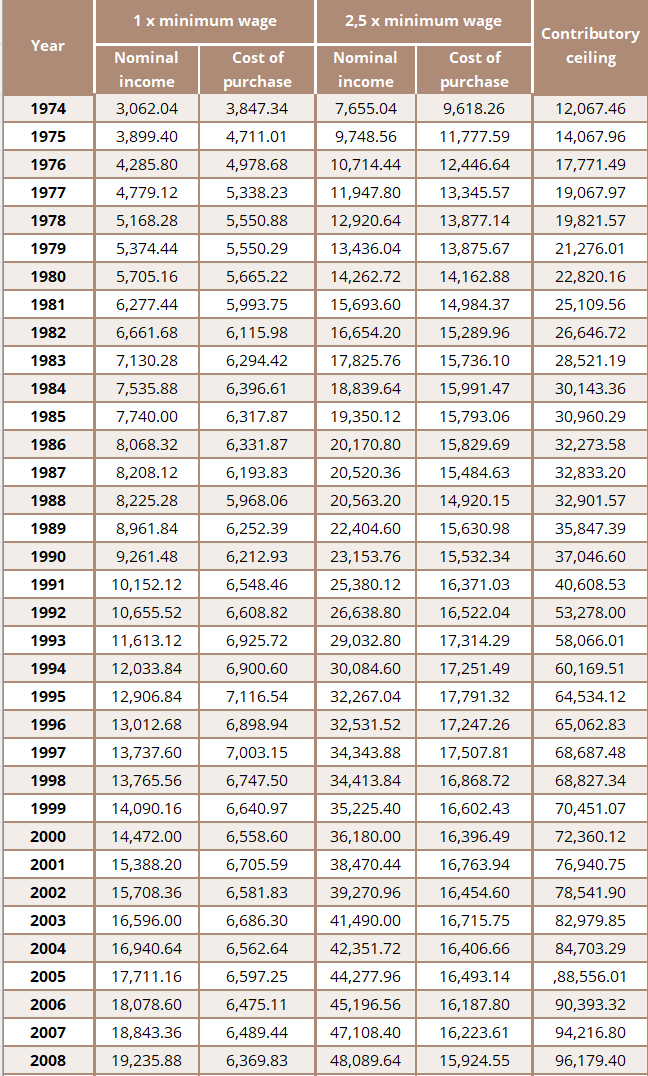
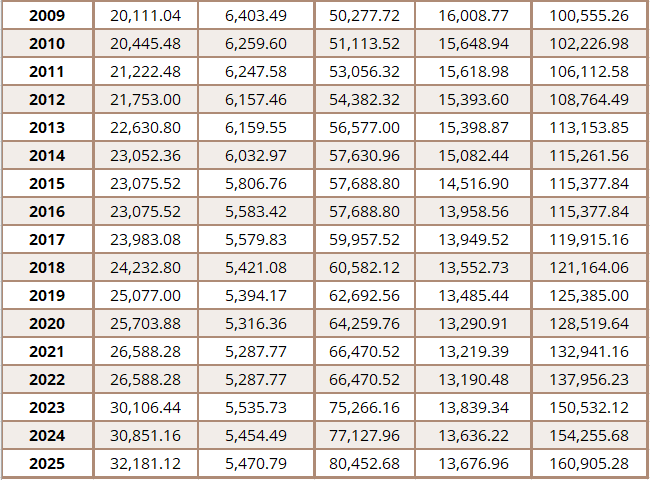
Generally, for one month of insurance to be retroactively covered, a contributory income corresponding either to the unskilled minimum wage during these periods, or to multiples of 1.5, 2.0 or 2.5 of this minimum, is debited at the request of the interested party. In no case may the incomes credited under compulsory insurance and retroactive purchase exceed the maximum contributory ceiling in force at the CNAP during the calendar year in question.
The amount to be paid for the retroactive coverage of insurance periods is calculated on the basis of the income chosen by the insured person using the overall contribution rate applicable at the time of receipt of the purchase application. The nominal amount of the contributions thus calculated is increased by compound interest at the rate of 4% per year. Interest accrues per full year from the year following the one to be retroactively covered until the end of the year preceding that of receipt of the application. The cost of the contributions is shared between the interested party and the State in the proportion of 2/3 for the interested party and 1/3 for the State. These contributions are fully tax-deductible.
EXAMPLE
From November 2004 to February 2006, Marie-Claude interrupted her professional activity to look after her minor children.
If Marie-Claude wishes to cover this period with a contributory income enabling her to increase her pension entitlements and to validate months potentially necessary to take early old-age pension, she has the option of retroactively purchasing these months.
In the case where she opts for the purchase of the months in question on the basis of the minimum wage, the cost of the purchase amounts to:
-
- for 2004: 2/12 × 6,562.64 = 1,093.77 euros
- for 2005: 12/12 × 6,597.25 = 6,597.25 euros
- for 2006: 2/12 × 6,475.11 = 1,079.19 euros
For the pension calculation, these 16 months will henceforth be taken into account as if Marie-Claude had worked at the minimum wage during this period.
If Marie-Claude makes the purchase in 2027 instead of 2026, the purchase price increases by 4%.
THE RETROACTIVE PURCHASE OF PERIODS IN THE EVENT OF DIVORCE:
Since 1 November 2018 and the divorce reform, spouses who have interrupted their career have the possibility of purchasing these years for their retirement, for half at the expense of the former spouse, but under certain conditions.
Indeed, the legislation now allows that, in the event of abandonment or reduction of professional activity by a spouse during the marriage for a period ending at the latest on the date of the divorce petition, the latter may request, before the divorce judgment and provided that at the time of the application they have not exceeded the age of 65, the court to proceed or to have proceeded with the calculation of a reference amount for the retroactive purchase, based on the difference between the respective incomes of the spouses during the period of abandonment or reduction of professional activity.
The spouse who remained in employment contributes half to the cost of the purchase, within the limits of the assets constituted by common or undivided property available after settlement of the liabilities.
The spouse who abandoned or reduced their activity may waive this retroactive purchase. This waiver may take place up to the divorce judgment. It cannot take place before the introduction of the divorce petition.
The determination of insurance units
Insurance periods are counted by calendar month. A full month is counted for months representing either 64 hours of work in the case of periods of professional activity, or 10 calendar days in other cases.
Fractions of months below these thresholds are carried forward to the following months and credited in the first month in which the total hours of activity will, taking into account the carry-forward, have reached the required threshold, whilst the contributory incomes are credited for the month to which they relate.
EXAMPLE
Jean-Luc works 60 hours in February, 50 hours in March and 40 hours in April.
February is not validated because Jean-Luc worked less than 64 hours that month. The 60 hours from that month are carried over to the following month.
Thus, even though he only worked 50 (<64) hours in March, this month will be validated as an insurance month due to the carryover of 60 hours from the previous month. In effect, it will be considered as if he had worked 110 hours (50+60).
Given that Jean-Luc only works 40 hours in April, and that there is no carryover from the previous month, this month will not be taken into account when determining his career length.
In practical terms, a person who works between 32 and 61 hours per month for 12 months will only have validated 6 months for pension insurance purposes.
It should be noted that, where several periods of insurance overlap during the same calendar month, the accounting cannot exceed one month. Therefore, simply adding together the periods of insurance validated in different countries to those validated in Luxembourg, without taking into account any overlaps, may result in an overestimation of an insured person’s total period of insurance.
EXAMPLE 1
Marie-Paule is compulsorily insured under the Luxembourg pension insurance scheme by virtue of her salaried activity. At the same time, she works as a self-employed person in France where she pays contributions to the French pension fund.
Even if, on her French career record, she accumulates months in France, and on her Luxembourg career statement she accumulates months in Luxembourg, for a given period, one month will count only once in order to determine the duration of her qualifying period: either in Luxembourg or in France.
The overlap of several insurance periods therefore does not allow her to retire earlier on an (early) pension. In order to determine her qualifying period under the pension insurance scheme, she cannot therefore simply add together the months appearing on her French statement and on her Luxembourg statement.
EXAMPLE 2
Jean-François is pursuing a university degree that may be recognised as periods of additional insurance.
During several months of his studies, Jean-François is engaged in professional activity.
As a month cannot be validated twice, in this case for periods of study and professional activity, each month of professional activity supersedes the month of study.
The restitution of reimbursed contributions
Persons who have benefited from a reimbursement of contributions may revive the rights initially attached to the relevant insurance periods by returning the amount of the reimbursed contributions, provided that at the time of the application they have neither exceeded the age of 65 nor are entitled to a personal pension.
The restitution includes the amount of the reimbursed contributions, revalued taking into account compound interest at the rate of 4% per full year from the year following that of the reimbursement of contributions until the end of the year preceding that of the restitution of contributions. The amount thus determined must be settled, on penalty of forfeiture, within 3 months following notification of the decision.
The restituted contributions are tax-deductible.
(last updated on 15.07.2026)
The aggregation of periods
At the time of retirement, all contribution periods completed either in an EFTA member country (i.e. the European Union, Iceland, Norway, Liechtenstein and Switzerland), or in a country with which Luxembourg has an agreement in the field of social security, are taken into account and aggregated for the entitlement and the calculation of the old-age pension. Each State is therefore required to take into account the insurance periods that have been completed in other countries.
This is the principle of the aggregation of insurance periods, which guarantees that the insurance or working periods completed in one State will be taken into account, if necessary, to open the entitlement to benefits in another State.
It should be noted, however, that entitlement to a pension in one country does not automatically trigger this entitlement in other countries – the conditions for entitlement, particularly those related to age, may differ from one country to another.
EXAMPLE
Marie-Rose worked for 17 years in Belgium, 18 years in France and 5 years in Luxembourg. At the age of 57, she is therefore entitled to a pension in Luxembourg, given that all her years of service (17 + 18 + 5) are taken into account when determining her qualifying period.
However, at that point, she will only be able to receive her Luxembourg pension and will have to wait until she reaches the legal age in France or Belgium to receive the respective pensions from those countries.
If, due to her very short career in Luxembourg, the Luxembourg pension would be insufficient for Marie-Rose, she would then be implicitly forced to extend her career until the legal retirement age in France or Belgium – in order to be able to receive these pensions as well – even if she is entitled to the Luxembourg pension well before that age.
(last updated on 15.07.2026)
The voluntary extension of the insurance career
A person who fulfils the conditions for an early old-age pension is not required to claim it immediately and may perfectly well extend their career by a few months or several years if they wish so. This choice allows them to remain in employment beyond the first possible departure date and to defer the start of the pension.
The continuation of professional activity results in the acquisition of additional rights, which automatically leads to an increase in the future pension amount. Each additional month or year validated is reflected in the pension calculation formula, through higher proportional increases. The impact of the career extension on the pension level may be simulated using our pension estimator. (See ‘The proportional increases and Examples of calculations for (early) old-age pensions’)
At the same time, the tax allowance for remaining in professional life, introduced by the law of 19 December 2025 and in vigour since 1 January 2026, aims to encourage this deferral of the early old-age pension by granting a targeted tax advantage to insured persons who continue to work whilst they already fulfil the conditions for an early old-age pension. Specifically, insured persons who have an entitlement to an early old-age pension, but choose not to make use of it (immediately) and to continue a professional activity, may benefit from a monthly tax allowance of 750 euros. In this context, an amount of 750 euros is exempted from tax each month on the insured person’s professional income, which reduces the taxable base, and therefore the tax due.
The tax allowance for remaining in professional life is subject of an application to the Direct Tax Administration. This application must be accompanied by a certificate from the CNAP attesting that the taxpayer fulfils the conditions for the pension entitlement. To benefit from the allowance, the employee has the allowance entered on their tax withholding card by attaching the certificate to their request for correction of the tax withholding card (form 164). If the allowance is not applied via withholding at source, it may still be claimed in the tax return or during the annual settlement.
(last updated on 15.07.2026)
The calculation of the old-age pension
The monthly old-age pension is composed of proportional increases and lump-sum increases. The lump-sum increases are granted according to the duration of insurance, whilst the proportional increases are granted according to the contributory professional incomes earned during the insurance career.
To the monthly pension is added, for the month of December, the end-of-year allowance.
The calculation of pensions is carried out first at index number 100 of the cost of living as at 1 January 1948 and for the base year 1984. This makes it possible to compare wages from different years. Once this step has been carried out, pensions benefit from a dual adjustment. They are adjusted to the evolution of real wages (revaluation and readjustment) as well as to the cost of living (indexation).
In order to facilitate the calculation of pensions, without having to refer to the formulas presented in this section, our Chamber has developed a tool enabling estimation of the pension and projection of its evolution as a function of the duration of career extension as well as the contributory income received during this period. This simulator is accessible online at calculatrice.pensions.lu.
(last updated on 15.07.2026)
The lump-sum increases
The lump-sum increases are granted according to the duration of insurance and are independent of the level of the insured person’s income. To calculate this duration all compulsory insurance, continued insurance, optional insurance, retroactive purchase periods and additional periods are taken into account, without the number of years credited being able to exceed 40.
Before the 2012 reform, the amount of the lump-sum increases for an insurance career of 40 years was 23.5% of the reference amount. The latter constitutes a parameter used to determine certain thresholds in relation to the pension calculation. It is fixed at 2,085 euros per year, at index number 100 of the cost of living as at 1 January 1948 and for the base year 1984.
However, the law of 21 December 2012 provided for the gradual increase of the lump-sum increases according to the year of retirement. In 2026, the amount of the lump-sum increases for a complete career (40 years) amounts to 25.075% of the reference amount, to reach 28% in 2052. This amount is identical for each insured person. The applicable percentage according to the year of retirement is indicated in the table at the next pages.
The lump-sum increases are acquired at 1/40 per year, completed or commenced, without the number of years credited being able to exceed 40.
For a complete career of 40 years or more, the lump-sum increases thus correspond to 25.075% of 2,085, i.e. 522.81 euros per year at index number 100 of the cost of living as at 1 January 1948 and for the base year 1984. Expressed in today’s euros, this amount corresponds to 522.81 × 9.9224 × 1.57 = 8,144.48 euros per year, i.e. 678.71 euros per month.
EXAMPLE 1
Jean-Pierre retires in 2026 and can demonstrate 33 years and 3 months of insurance with the CNAP. He will obtain lump-sum increases equal to 34/40 of 522.81 euros, which is equivalent to 444.39 euros per year at index number 100 of the cost of living as at 1 January 1948 and base year 1984.
This corresponds, at 1 June 2026, to:
444.39 × revaluation factor of 2022 × current index/100
= 444.39 × 1.57 × 9.9224
= 6,922.81 euros per year, i.e. 576.90 euros per month.
EXAMPLE 2
Jean-Charles retires in 2026 and can demonstrate 43 years and 9 months of insurance with the CNAP. He will obtain lump-sum increases equal to 40/40 of 522.81 euros per year at index number 100 of the cost of living as at 1 January 1948 and base year 1984.
This corresponds, at 1 June 2026, to:
522.81 × revaluation factor of 2022 × current index/100
= 522.81 × 1.57 × 9.9224
= 8,144.48 euros per year, i.e. 678.71 euros per month.
(last updated on 15.07.2026)
The proportional increases
The proportional increases correspond to the product of the multiplication of a percentage rate, (which changes according to the year of retirement), by the sum of the contributory incomes credited.
Before the reform introduced by the law of 21 December 2012, this percentage rate was fixed at 1.85%. However, the new law provides for a gradual reduction of this rate, which thus falls from 1.85% to 1.6% by 2052. For insured persons whose pension entitlement begins in 2026, this rate is now only 1.763%. For persons retiring in the following years, this rate decreases progressively to reach 1.6% in 2052. This amount is identical for each insured person. The applicable percentage according to the year of retirement is indicated in the table on the next pages.
This rate may be increased with staggered proportional increases which are conditional upon 2 criteria: age and duration of compulsory insurance periods.
The 2012 reform redefined the conditions for granting and the level of the staggered proportional increases. Henceforth, the granting is subject to a single condition of a minimum threshold, equal to the sum of the age and the compulsory insurance periods, which evolves according to the year of retirement. This threshold stands at 93 in 2013, to progressively reach 100 in 2052.
The rate of the staggered proportional increases is gradually increased according to the year of retirement from 0.011% per additional year beyond the threshold (relative to the ‘normal’ rate described above) in 2013, to 0.025% in 2052.
Specifically, the increase in the proportional increment rate is calculated on the basis of the difference between, on the one hand, the age of the beneficiary increased by the number of years of contribution (only full years under periods effective of compulsory insurance) and, on the other hand, the reference threshold for the year of retirement (set at 95 for 2026). Thus, for each unit exceeding this threshold, a staggered increase in the rate of proportional increases (of 0.016% in 2026) is provided. However, the rate of staggered proportional increases may not exceed a total of 2.05%.
If the new formula gives more significant staggered proportional increases than under the former legislation, the conditions for granting are also increasingly restrictive over time. Thus, in 2052, an insured person aged 60 who can demonstrate 40 years of career will no longer be able to benefit from the staggered increase (40 + 60 = 100).
EXAMPLE
Marie-Louise retires in 2026 at the age of 60 years and 3 months and can demonstrate 40 years and 11 months of compulsory periods. The rate of staggered proportional increases applying to her is:
60 + 40 = 100
100 – 95 = 5
5 × 0.016% = 0.08% staggered increase in the rate of proportional increases, which thus amounts to 1.763% + 0.08% = 1.843%.
In contrast, in 2052, a retirement claimant of the same age (60) and having the same duration of contributions (40) will not benefit from any increase in their rate of proportional increases. Indeed, the threshold will then be set at 100 (100 – 100 = 0).
To obtain the sum of contributory income used in calculating proportional increases, these are reduced per calendar year to the number 100 of the weighted cost of living index as at 1 January 1948, based on the annual average applicable index rates of the sliding wage scale.
These amounts are then adjusted to the standard of living in a base year, which is 1984. To this end, they are divided by revaluation factors that express the relationship between the average gross wage level for each calendar year and that of the base year. If the revaluation factor for a given year is not yet known, then the rate for the last year for which it is known is used for the transition to the base year 1984.
It should be noted that the sum of all contributory income at 100 on the weighted cost of living index and in the base year 1984 appears on the career statement, at the bottom left of the document, preceded by ‘B–’.
EXAMPLE
In order to convert a 1990 income equivalent to 21,969.48 euros (as stated in the career statement provided by the Joint Social Security Centre [CCSS − Centre commun de la sécurité sociale]) to an income indexed at 100 and based on 1984, it must be divided by the average index application rate for 1994 and by the revaluation factor for that year (these amounts are shown in the table on the next pages).
Thus, an income of 21,969.48 euros in 1990 corresponds to an income of:
21,969.48 / 4.5786 / 1.103
= 4,350.22 euros at index number 100 of the cost of living on 1 January 1948 and base year 1984.
This calculation is performed for each year for which an insured person has contributory income. The sum of this income is then multiplied by the rate of proportional (staggered) increases applicable to the insured person.
For the baby-years, the contributory income taken into account corresponds to the monthly average income earned in the compulsory insurance periods during the 12 months of insurance immediately preceding the month of childbirth or adoption, reduced by any contributory income on other grounds during the application of the baby-years. This income taken into account may not be less than 270.28 euros per child per month at the index number 100 of the cost of living on 1 January 1948 and the base year 1984 (4,341.88 euros on 1 June 2026).
Table showing lump-sum increases, as well as rates, thresholds and staggered increases in proportional increases according to the year of retirement:
Table showing lump-sum increases, as well as rates, thresholds and staggered increases in proportional increases according to the year of retirement.
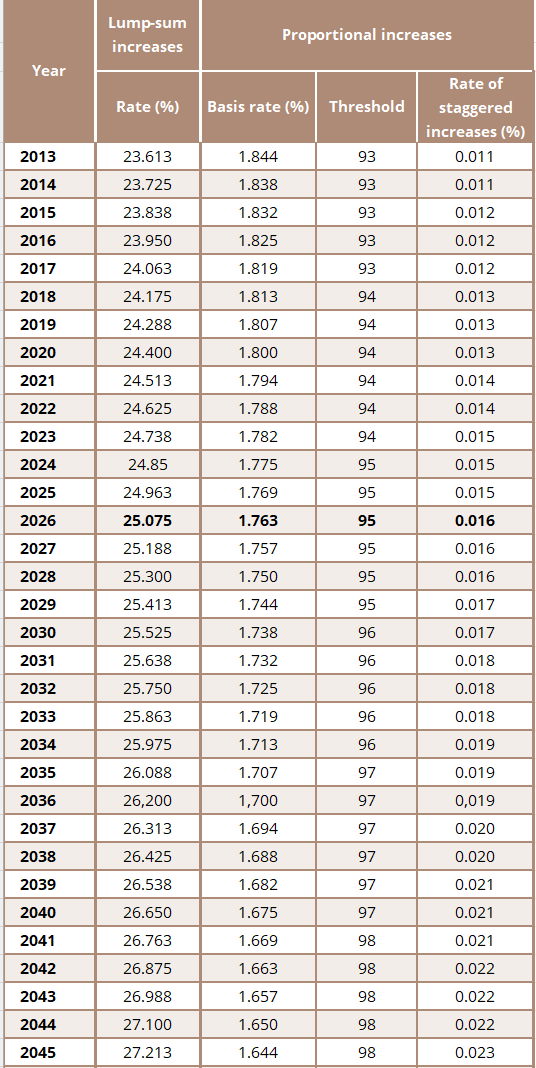
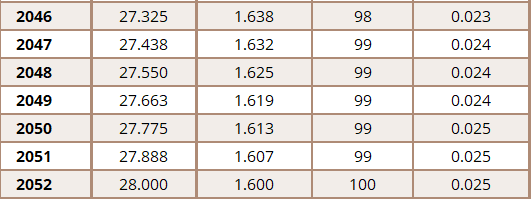
(last updated on 15.07.2026)
The end-of-year allowance
The law of 28 June 2002 introduced an end-of-year allowance for persons who are entitled to a pension on 1 December.
For beneficiaries of an old-age, invalidity or survivor’s pension, the allowance amounts to 1.67 euros for each year of insurance, completed or commenced, under compulsory insurance, continued insurance, optional insurance, retroactive purchase periods and additional periods, without the number of years credited being able to exceed 40. This amount corresponds to index number 100 of the weighted cost-of-living index as at 1 January 1948 and the base year 1984.
The beneficiary of a pension who has accumulated 40 years or more of insurance is therefore entitled, in December 2026, to an allowance amounting to 1.67 × 1.57 × 9.9224 = 26.01554 euros per year of recognised insurance, i.e. an annual amount of 1,040.62 euros for a complete career of at least 40 years.
If the pension is not paid to the beneficiary for the entire calendar year, the allowance is reduced by 1/12 for each full calendar month.
The amount of the allowance is not taken into account for the application of the provisions relating to the cumulation of pensions with other income, but it is reduced in the same proportion as the pension by the effect of these provisions.
(See ‘The cumulation of an (early) old-age pension with other income’)
It should be noted that since the law of 21 December 2012, the upkeeping of the end-of-year allowance is linked to the contribution rate. Following the new 2025 reform, the law now provides that if the overall contribution rate for pension insurance exceeds 25.5%, the end-of-year allowance is no longer due.
(last updated on 15.07.2026)
Indexation, revaluation and readjustment
Pensions benefit from a dual adjustment. Through revaluation and readjustment, they are adjusted to the evolution of real wages and, through indexation, they are adjusted to the cost-of-living index, i.e. to consumer prices.
INDEXATION OF PENSIONS
Pensions are calculated at index number 100 of the weighted cost-of-living index as at 1 January 1948, so as to take into account the evolution of wages during the insured person’s career through the mechanism of the sliding wage scale (index tranches).
After they have been granted, pensions evolve with the sliding wage scale, just like wages and salaries.
REVALUATION OF PENSIONS
The law of 21 December 2012 introduced a differentiation between, on the one hand, the mechanism for the revaluation of wages, namely the updating of the wages recorded in the career to base year 1984 values at the wage level of the economy at the time of the pension calculation and, on the other hand, the readjustment mechanism which consists of annually adjusting, during retirement, the level of pensions to the evolution of wages.
Concerning the revaluation at the time of the award of the pension, the law provides that the amount of pensions in base year 1984 are multiplied by the revaluation factor of the fourth year preceding the start of the pension entitlement. This revaluation factor is fixed by Grand-Ducal regulation.
Specifically, for the calculation of the pension of an insured person who retires in 2026, the revaluation factor of 2022 is applied, which is fixed at 1.57.
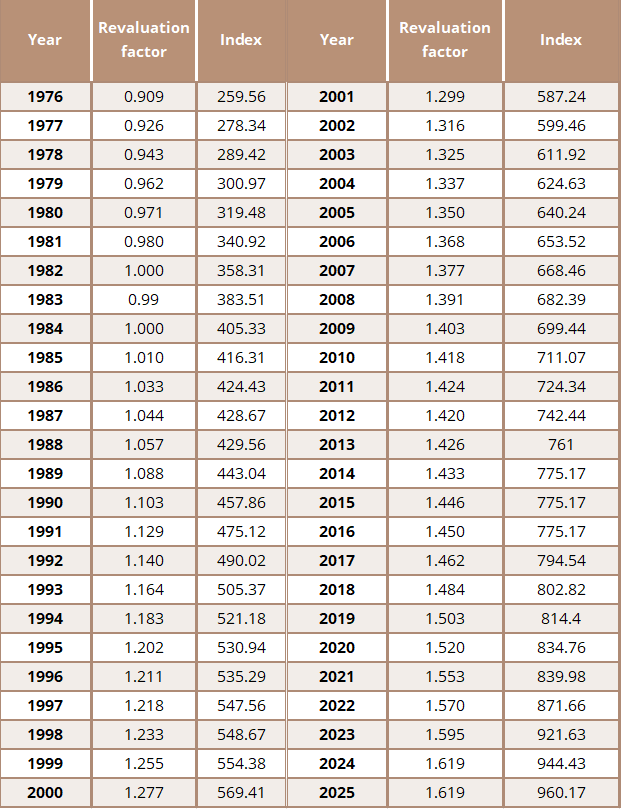
Readjustment of pensions
As regards the readjustment of pensions during retirement, the law of 21 December 2012 provides for a new mechanism so that the adjustment of pensions to real wages is no longer automatic and depends on the financial situation of the pension scheme. In the event that the pure pay-as-you-go premium exceeds the overall contribution rate, and therefore that the current expenditure of the CNAP exceeds the contribution revenues, a moderating mechanism is triggered and the readjustment of pensions being paid will be, at most, equal to half of the evolution of wages. (See ‘The pure pay-as-you-go premium’)
Specifically, the pensions to which the revaluation and indexation mechanism, described above, has been applied are multiplied by the product of the different readjustment factors determined per calendar year, from the year following the commencement of the pension entitlement.
For a calendar year, the readjustment factor is obtained by adding 1 to the product of the multiplication of the annual rate of variation of the revaluation factor, between the penultimate year and the year preceding it, by the readjustment moderator applicable for the penultimate year.
The law sets this readjustment moderator at 1. Every year, the government examines whether or not to proceed with a revision of the readjustment moderator through legislation. If the pure pay-as-you-go premium of the penultimate year preceding that of the revision exceeds the overall contribution rate, the government submits to the Chamber of Deputies a report accompanied, where applicable, by a bill setting a new readjustment moderator at a value equal to or less than 0.5 for the years from the year preceding the revision.
However, the readjustment moderator may again be increased to a value not exceeding 1 for the years from the year preceding the revision, if the overall contribution rate for the penultimate year preceding that of the revision exceeds the pure pay-as-you-go premium.
EXAMPLE
Marie-Louise has a pension of 3,500 euros in 2025. In January 2026, as for each year, pensions in payment, such as Marie-Louise’s, are readjusted with the readjustment factor of 2026.
Readjustment factor of 2026:
1 + (variation of the revaluation factor of 2024 relative to the revaluation factor of 2023) × moderator of 2024.
Fixed by Grand-Ducal regulation, the revaluation factor of 2023 stands at 1.595 and that of 2024 at 1.619. This represents an increase of 1.5%. The readjustment moderator of 2024 remained fixed at 1.
1 + 0.015 × 1 = 1.015
The pension of Marie-Louise, like that of all other retirees, will therefore increase by 1.5%.
From January 2026, Marie-Louise’s pension thus amounts to 3,500 × 1.015 = 3,552.50 euros.
(last updated on 15.07.2026)
The minimum pension
No old-age pension may be less than 90% of the reference amount (fixed, at index number 100 of the cost of living as at 1 January 1948 and for the base year 1984, at 2,085 euros per year) where the insured person has completed a qualifying period of at least 40 years under compulsory insurance, continued insurance, optional insurance, retroactive purchase or additional periods.
If the insured person has not completed this qualifying period of 40 years, but can demonstrate 20 years of insurance under the same types of periods, the minimum pension is reduced by 1/40 for each year, even commenced, that is missing.
In June 2026, the monthly minimum pension of an insured person who can demonstrate 40 years of affiliation is equivalent to:
90% of 2,085 × revaluation factor of 2022 × current index/100
= 1,876.50 × 1.57 × 9.9224
= 29,232.43 euros per year, i.e. 2,436.04 euros per month.
The minimum pension of an insured person who has only an affiliation of 26 years is 1,583.43 euros (26/40 of 2,436.04 euros).
(last updated on 15.07.2026)
The maximum pension
No personal pension may exceed 5/6 of five times the reference amount (fixed, at index number 100 of the cost of living as at 1 January 1948 and for the base year 1984, at 2,085 euros per year).
In June 2026, the maximum pension of an insured person is equivalent to:
5/6 × 5 × 2,085 × revaluation factor of 2022 × current index/100
= 8,687.50 × 1.57 × 9.9224
= 135,335.33 euros per year, i.e. 11,277.94 euros per month.
(last updated on 15.07.2026)
The calculation in the case of a mixed career
In the case of a so-called mixed career, the applicant receives a pension from each State in which they were insured. The amount of each pension to which the cross-border worker is entitled is proportional to the number of years of contributions completed in the country concerned.
Each State where the cross-border worker was insured carries out the following calculation:
- National pension: this is calculated on the basis of national legislation, taking into account only periods worked in the country for longer than the minimum affiliation period;
- Theoretical amount: the competent institution calculates the theoretical amount of the old-age benefit that would have been due if the insured person had completed all periods of insurance, including those completed abroad, under its legislation; proportional pension: based on the theoretical amount, it sets the actual amount in proportion to the length of the periods of insurance actually completed under its legislation.
The competent pension fund then pays the higher of the two pensions, generally the proportional pension.
(last updated on 15.07.2026)
Examples of calculations for (early) old-age pensions
Example 1 – ‘normal‘ career in Luxembourg
Jean-Christophe was born on 3 June 1965. He began working on 1 July 1984 and has had a steady career, as shown on his career statement, as follows:
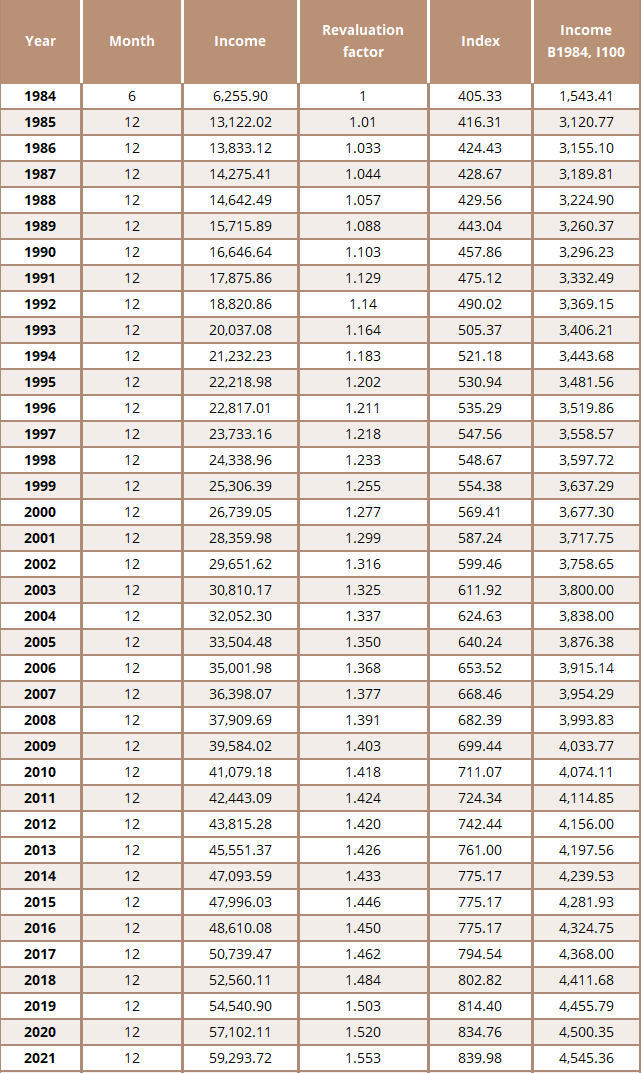
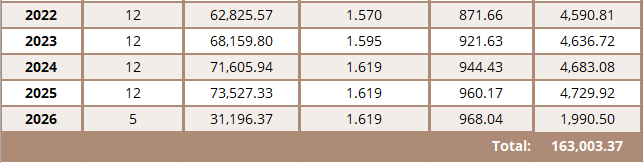
On 14 June 2026, Jean-Christophe is 61 years old. At that point, he has already worked for more than 40 years. He has 503 months of compulsory insurance periods. Jean-Christophe is therefore entitled to an early old-age pension.
The amount of Jean-Christophe’s pension, on the base year 1984 and on index number of 100, is calculated as follows:
- Lump-sum increases: Jean-Christophe has a career spanning more than 40 years, so he is entitled to the full lump-sum increase. For those retiring in 2026, this amount is 25.075% of 2,085 euros, or 522.81 euros per year.
- Proportional increases: In 2026, the ‘normal’ rate of proportional increases is 1.763%. However, due to his career, Jean-Christophe can benefit from a staggered increase in his rate.
Age + number of full years of compulsory periods: 61 + 41 = 102
Number of staggered increases: 102 – 95 = 7
Staggered increases of the rate of proportional increases: 7 × 0.016% = 0.112% Rate of proportional increases for Jean-Christophe: 1.763% + 0.112% = 1.875%
Proportional increases: 1.875% × Total contributory income at index 100 and in base year 1984 = 1.875% × 163,003.37 = 3,056.31 euros per year.
The annual pension based on 1984 at index 100 therefore amounts to: 522.81 + 3,056.31 = 3,579.12 euros.
To obtain the actual amount in 2026 at the current index, it must be multiplied by the 2022 revaluation factor and the current index:
3,579.12 × 2022 revaluation factor × current index / 100
= 3,579.12 × 1.57 × 9.9224
= 55,756.13 euros per year, or 4,646.34 euros per month.
Added to this is the end-of-year allowance, paid together with the December pension.
Example 2 – Luxembourg career with minimum pension
Marie-Louise was born on 6 June 1961. She has a fragmented compulsory insurance career, which is shown on her career statement as follows:
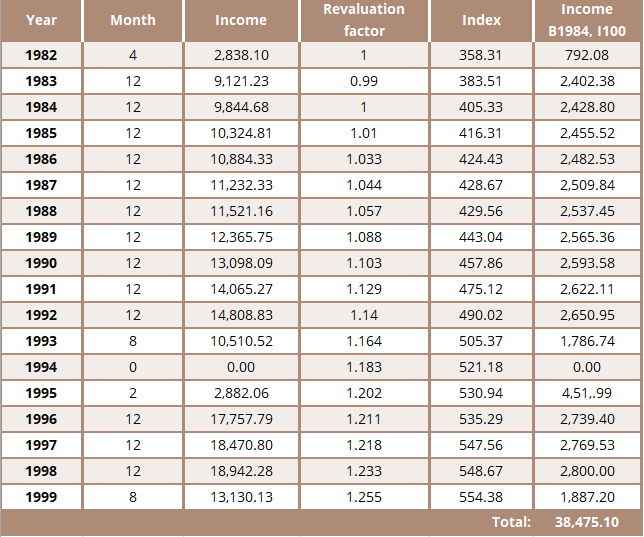
Beyond this information, the following information is available:
- Marie-Louise pursued studies until the beginning of her professional activity.
- She had two children: one was born on 16.07.1991 and the other was born on 08.09.1997.
At the age of 65, Marie-Louise is indeed entitled to a statutory old-age pension due to the fact that she justifies more than 10 years of compulsory insurance periods.
To determine the lump-sum increases, it is first necessary to determine the number of insurance months of Marie-Louise:
- The months from her 18th birthday until the beginning of her professional activity are taken into account as additional study periods: 39 months
- The period from 16.07.1991 – 15.07.1997 could be recognised as a period of education of a child under the age of 6. Among this period, only that from 01.09.1993 – 30.10.1995 is not already recognised as a compulsory period: 26 months
- The period from 08.09.1997 – 07.09.2003 could also be recognised as a period of education of a child under the age of 6. Among this period, only that from 01.09.1999 – 07.09.2003 is not already recognised as a compulsory period: 48 months
With her compulsory periods, Marie-Louise therefore justifies 291 months of pension insurance.
The amount of Marie-Louise’s pension, in base year 1984 and at index number 100, is calculated as follows:
- Lump-sum increases: Given that a year begun counts as a full year for the purpose of lump-sum increases, Marie-Louise is entitled to 25/40 of the lump-sum increases, that is to say 25.075% of 2,085 × 25/40 = 326.76 euros per year.
- Proportional increases: Due to her contributable income, Marie-Louise is entitled to 1.763% × 38,475.11 = 678.32 euros per year in respect of proportional increases. Indeed, because of her short career (14 full years of compulsory periods), she is not entitled to staggered increases of her rate of proportional increases.
The annual pension in base year 1984 at index 100 therefore amounts to: 326.76 + 678.32 = 1,005.08 euros.
Given that, for the minimum pension, only full years are taken into account, this amounts, with a career such as that of Marie-Louise, to: 90% of 2,085 × 24/40 = 1,125.90 euros per year in base year 1984 and at index 100.
Marie-Louise is therefore indeed entitled to this minimum pension, which is higher than her ‘normal’ pension.
To obtain the effective amount in 2026 and at the current applicable index, it must be multiplied by the 2022 revaluation factor and the current index:
1,125.90 × 2022 revaluation factor × current index / 100
= 1,125.90 × 1.57 × 9.9224
= 17,539.46 euros per year, that is 1,461.62 euros per month.
In addition to this, there is also the end-of-year allowance (25/40), paid together with the pension for the month of December.
Example 3 – migratory career
Jean-Philippe was born on 24 May 1961. He has had a career in several countries. His Luxembourg career statement shows the following situation:
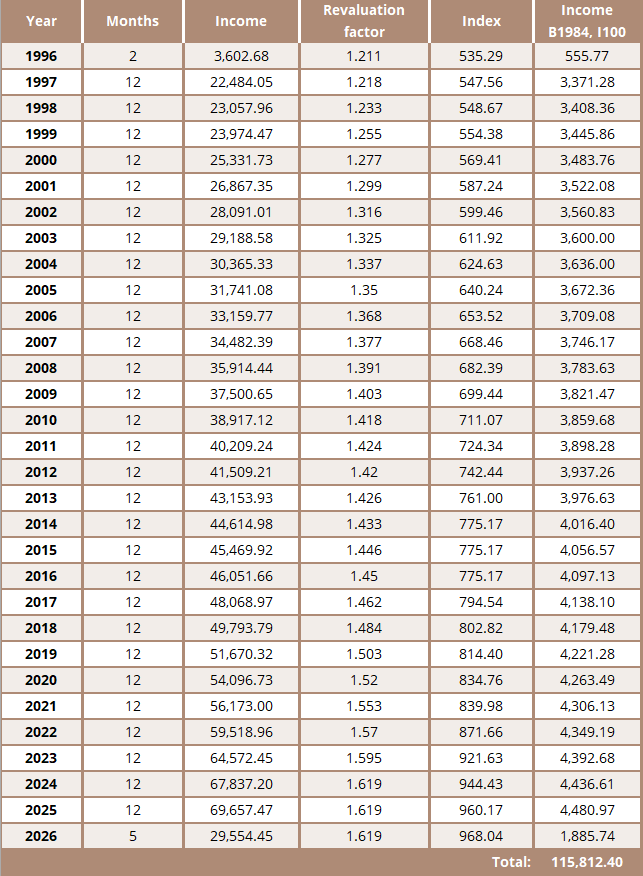
Beyond these months of compulsory insurance in Luxembourg, Jean-Philippe’s insurance record is as follows:
- Periods of studies until the age of 24 years and 3 months: 75 months
- 134 months of compulsory insurance in France
Being 65 years old, Jean-Philippe is indeed entitled to a statutory old-age pension – he could also have retired earlier on an early old-age pension.
To determine the level of Jean-Philippe’s pension, two calculations are carried out: the national pension and the proportional pension. The higher of the two amounts is then paid to him.
The national pension
For the calculation of the national pension, insurance periods completed under another pension scheme are completely disregarded.
The amount of Jean-Philippe’s national pension, in base year 1984 and at index number 100, is calculated as follows:
- Lump-sum increases: Jean-Philippe justifies 355 months of compulsory insurance in Luxembourg and 75 months as study periods. Given that a year begun counts as a full year for the purpose of lump-sum increases, Jean-Philippe is entitled to 36/40 of the lump-sum increases, that is to say 25.075% of 2,085 × 36/40 = 470.53 euros per year.
- Proportional increases: Due to his contributable income in Luxembourg, Jean-Philippe is entitled to 1.763% × 115,812.40 = 2,041.77 euros per year in respect of proportional increases. Indeed, on the basis of his career in Luxembourg alone (29 full years of compulsory periods), he is not entitled to staggered increases of his rate of proportional increases.
The annual national pension in base year 1984 at index 100 therefore amounts to: 470.53 + 2,041.77 = 2,512.30 euros.
The proportional pension
For the calculation of the proportional pension, a theoretical pension is first calculated which would have been due if the insured person had completed all insurance periods, including those completed abroad, under its legislation. To determine this amount, the ratio between compulsory periods in Luxembourg and total compulsory periods is decisive.
For Jean-Philippe this ratio amounts to: 355 / (355 + 134) = 0.72597
Jean-Philippe’s theoretical pension, in base year 1984 and at index number 100, is calculated as follows:
- Theoretical lump-sum increases: Jean-Philippe justifies 564 months of insurance in total. He benefits from the entirety of the lump-sum increases. For retirements in 2026, this amount is 25.075% of 2,085 euros, that is 522.81 euros per year.
- Theoretical proportional increases: In 2026, the ‘normal‘ rate of proportional increases amounts to 1.763%. By virtue of his total career, Jean-Philippe may, however, benefit from a staggered increase of his rate.
Age + number of full years of compulsory periods: 65 + 40 = 105
Number of staggered increases: 105 – 95 = 10
Staggered increase of the rate of proportional increases: 10 × 0.016% = 0.16%
Rate of proportional increases for Jean-Philippe: 1.763% + 0.16% = 1.923%
Theoretical staggered proportional increases: 1.923% × Sum of all contributable income at index 100 and in base year 1984 of Luxembourg / Ratio between compulsory periods in Luxembourg and total compulsory periods = 1.923% × 115,812.40 / 0.72597 = 3,067.71 euros per year.
The annual theoretical pension in base year 1984 at index 100 therefore amounts to: 522.81 + 3,067.71 = 3,590.52 euros.
This theoretical pension must then be multiplied by the ratio between compulsory periods in Luxembourg and total compulsory periods in order to take into account that Jean-Philippe did not complete his entire professional career in Luxembourg.
The annual proportional pension in base year 1984 at index 100 therefore amounts to: 3,590.52 × 0.72597 = 2,606.62 euros.
Since the proportional pension is higher than the national pension, it is this pension that is paid to Jean-Philippe.
To obtain the effective amount in 2026 and at the current applicable index, it must be multiplied by the 2022 revaluation factor and the current index:
2,606.62 × 2022 revaluation factor × current index / 100
= 2,606.62 × 1.57 × 9.9224
= 40,606.33 euros per year, that is 3,383.86 euros per month.
In addition to this, there is also the end-of-year allowance, paid together with the pension for the month of December. To determine the level of the end-of-year allowance, account is again taken of the proration used to calculate the theoretical pension. Given that Jean-Philippe justifies a complete career (of more than 40 years) in total and 72.6% of his compulsory periods in Luxembourg, he will be entitled to 72.6% of the full end-of-year allowance.
(last updated on 15.07.2026)
The cumulation of an (early) old-age pension with other income
Cumulation of an early old-age pension and professional income
Luxembourg law allows pensioners over the age of 65 to engage in any professional occupation. They are therefore free to combine their statutory old-age pension with income from employment.
The situation is different when there is a combination of professional income and early old-age pension before the age of 65. Since the law of 19 December 2025, no distinction is made between income from salaried employment and income from self-employment under the rules on anti-cumulation.
In principle, recipients of early old-age pensions may only engage in insignificant or occasional professional activity. Insignificant or occasional activity is defined as any continuous or temporary activity generating income in Luxembourg or abroad which, spread over a calendar year, does not exceed one-third of the unskilled social minimum wage per month. The monthly minimum wage currently stands at 2,703.74 euros, with one-third equivalent to 901.25 euros.
Thus, recipients of early old-age pensions whose salary, spread over a year, does not exceed one-third of the minimum wage will not see their pension reduced.
The anti-cumulation provisions
If the gross professional income, spread over a calendar year, exceeds one third of the minimum wage, anti-cumulation provisions apply. These anti-cumulation provisions depend on an individual ceiling corresponding either to the average of the five highest contributory annual incomes in the insured person’s insurance career, or to the reference amount increased by 50% (4,060.06 euros per month as at 1 June 2026) if this amount is higher.
The law therefore does not necessarily set a maximum number of hours that a pensioner can continue to work, but rather a maximum amount of salary that they can earn in addition to their pension.
As for the calculation of the individual ceiling
The average of the five highest contributory annual incomes in the insurance career is determined in the base year 1984 and at index number 100. It is therefore not sufficient to identify the five highest amounts on an insured person’s career statement.
As with the calculation of pensions, the income for each year is first divided by the revaluation factor for that year and by the average application index rate of salaries for that year to take into account changes in both the cost of living and real wages.
In the case of a migratory career and the calculation of a proportional pension taking into account periods completed abroad, the individual ceiling is prorated in the same way as the proportional pension. This does not apply to the ceiling equivalent to one third of the minimum wage.
The rules on anti-cumulation are as follows:
- If the combined amount of the early old-age pension and professional income exceeds the ceiling (set at the average of the five highest contributory annual incomes during the insurance career or at the reference amount increased by 50% if this amount is higher), the pension is reduced by the amount exceeding this ceiling.
- When professional income exceeds the ceiling, the pension is refused or withdrawn.
EXAMPLE 1
For the sake of simplicity, calculations are made for the month of June 2026. In fact, all amounts are recorded at their reduced value to index 100 on 1 January 1948 and defined for the base year 1984. The income in compe-tition with the pension is reduced to the level of the base year 1984 by dividing it by the last known revaluation factor and to the index number 100 by dividing it by the index.
Marie-Claudette receives an early old-age pension of 2,600 euros per month (31,200 euros per year) and continues to receive a monthly salary of 2,500 euros (30,000 euros per year).
Let us assume that the average of the five highest contributory incomes in Marie-Claudette’s insurance career amounts to 50,000 euros at the current index and revaluation factor. This amount is higher than the reference amount increased by 50% (48,720.72 euros per year).
The salary received is higher than one third of the minimum wage – therefore, the anti-cumulation provisions apply. The total salary and pension is 61,200 euros (31,200 + 30,000).
The combined amount of the annual pension and annual salary exceeds the average of the five highest salaries in the insurance career by 11,200 euros (61,200 – 50,000).
This amount is therefore deducted from Marie-Claudette’s old-age pension, who continues to receive a pension of 20,000 euros per year (31,200 – 11,200), or 1,666.67 euros per month.
EXAMPLE 2
For the sake of simplicity, calculations are made for the month of June 2026. In fact, all amounts are recorded at their reduced value to index 100 on 1 January 1948 and defined for the base year 1984. The income in competition with the pension is reduced to the level of the base year 1984 by dividing it by the last known revaluation factor and to the index number 100 by dividing it by the index.
Jean-Claude receives a monthly early old-age pension of 1,900 euros (i.e. 22,800 euros per year) and continues to receive a monthly salary of 1,225 euros (i.e. 14,700 euros per year).
Let us assume that the average of the five highest contributory incomes in Jean-Claude’s insurance career amounts to 100,000 euros at the current index and revaluation factor. This amount is higher than the reference amount increased by 50% (48,720.72 euros).
Let us also assume that, of his total 40 years of compulsory insurance periods, only 15 were completed in Luxembourg.
In this case, Jean-Claude’s individual ceiling amounts to 100,000 × 15 / 40 = 37,500.
The salary received is higher than one third of the minimum wage – therefore, the anti-cumulation provisions apply. The total salary and pension amount to 37,500 euros (22,800 + 14,700).
As the combined amount of the annual pension and annual salary does not exceed the prorated average of the five highest salaries in the insurance career, there is no need to apply a reduction to the early old-age pension.
Also, in order to spare readers from having to consult the rather complicated provisions of the Social Security Code, the CSL has developed a tool, available on its website, which automatically calculates the amount of early old-age pension in the event of a cumulation with a salary.
The anti-cumulation provisions remain valid until the age of 65. From that point onwards, old-age pensions become normal old-age pensions and are no longer subject to the anti-cumulation provisions. Salaries or income earned during the early old-age pension period – which are subject to ordinary salary deductions – are then taken into account and give rise to a new proportional increase.
Cumulation of an (early) old-age pension and an accident pension
In the event of a combination of an old-age or early old-age pension with an accident pension, the pension is reduced to the extent that, together with the accident pension, it exceeds:
- either the average of the five highest annual incomes during the insurance career, without this average being less than the reference amount increased by 20% (3,248.05 euros per month as at 1 June 2026);
- or the professional income used as the basis for calculating the accident pension, if this other method of calculation is more favourable.
It should be noted that this anti-cumulation rule only applies to beneficiaries of an accident pension for an accident that occurred before 1 January 2011. Accident pensions granted after this date cease to be paid when the beneficiary reaches the age of 65 or in the event of the granting of an early old-age pension.
(last updated on 15.07.2026)
The refixing of the pension amount
Beyond indexation and readjustment, early old-age pensions are recalculated only once a year on 1 May 85. Apart from this automatic review, a new calculation is carried out in the following cases:
- if the beneficiary’s professional income increases by more than 25%;
- at the beneficiary’s request if they can prove a decrease in their income of at least 10% over a period of three months;
- when the beneficiary resumes or gives up their professional activity.
Furthermore, when the early old-age pension is converted into a normal old-age pension, the wages or income earned during the early old-age period – which are subject to ordinary wage deductions – are taken into account and give rise to a new proportional increase.
(last updated on 15.07.2026)
The progressive pension
The pension reform initiated by the Law of 19 December 2025 introduced a new progressive pension scheme. This scheme should not be confused with the progressive early retirement scheme. (See ‘Thematic Box II: Early retirement’)
(last updated on 15.07.2026)
The beneficiaries
To be eligible for progressive pension, employees must meet the following conditions:
- they must be eligible for early old-age pension; (See ‘The early old-age pension’)
- they must have held their position for at least 3 years, working a minimum of 75% of full-time hours; and
- they must be granted a reduction in working hours by their employer of at least 25% of their previous working hours, without the remaining working hours being less than 16 hours per week.
Due in particular to the need to obtain the employer’s agreement, the progressive pension cannot therefore be considered a genuine right for the employee.
(last updated on 15.07.2026)
The application procedure
Before applying for a reduction in working hours with a view to taking progressive pension, employees must obtain a certificate from the National Pension Insurance Fund (CNAP – Caisse nationale d’assurance pension) indicating the date on which they become eligible for early old-age pension. The time required to issue such a certificate depends on the insured person’s career and the availability of the information needed to determine this date. (See ‘Preliminary steps before the pension application’)
The employee must then submit their request for a reduction in working hours to their employer, either by registered letter, by hand delivery to the employer or their representative, or by email, all with acknowledgement of receipt, at least four months before the desired start date of the change. Their request must be accompanied by the certificate issued by the CNAP. The employer must respond to the employee’s request within one month.
To be eligible for progressive pension, and for any subsequent reduction in working hours, the employee must send the amendment providing for the reduction in working hours to the CNAP at least two months before the planned implementation of the reduction. The CNAP shall inform the employer and the employee of their eligibility for the progressive pension no later than one month before the planned implementation of the reduction. If the competent pension fund refuses to grant eligibility, the amendment shall be considered null and void.
(last updated on 15.07.2026)
The progressive pension benefit
Employees eligible for progressive pension receive, in addition to their salary reduced in proportion to the hours worked, a progressive pension benefit. This benefit corresponds to the product of the early old-age pension accrued (increased by the monthly end-of-year allowance) and the rate of reduction in working hours agreed with the employer.
EXAMPLE
Jean-Martin earns a monthly salary of 5,000 euros. If he took early old-age pension, he would be entitled to a pension of 3,000 euros (including monthly end-of-year allowance).
If Jean-Martin reduces his working hours by 40% in view of his progressive pension, he will continue to receive:
(1 – 40%) × 5,000 = 3,000 euros as his monthly salary, and
40% × 3,000 = 1,200 euros as his progressive pension benefit.
The progressive pension benefit, as well as the related social security contributions and taxes, are paid by the employer to the employee, with the employer being reimbursed monthly by the CNAP. At the employer’s request, the CNAP may agree to pay the progressive pension benefit directly to the employee.
In terms of social security and taxation, the progressive pension allowance is treated as an early old-age pension. For tax purposes, this means that a second tax card is issued, while in terms of social security, it means that the same social security contributions are deducted as for an old-age pension. (See ‘Long-term care insurance and healthcare insurance’)
(last updated on 15.07.2026)
The end of the progressive pension
Entitlement to the progressive pension benefit shall automatically cease:
- from the date on which the conditions for entitlement to an old-age pension from the age of 65 are met;
- from the date on which the employee, at his request, becomes eligible for an early old-age pension or an invalidity pension;
- on the date of the employee’s death;
- on the date on which the employee takes up or resumes an activity exceeding the working hours set out in the amendment agreed for the purpose of admission to the progressive pension; or
- from the date on which the employee takes up or resumes another activity that provides him with income that, over a calendar year, exceeds half of the social minimum wage applicable to the employee concerned per month.
In the case of an employee who has been made redundant as part of a collective redundancy, dismissed for reasons not related to their personal conduct, or whose employment has been terminated by operation of law, the CNAP is responsible for paying the progressive pension allowance directly.
(last updated on 15.07.2026)
The child-rearing allowance ('Mammerent')
The beneficiaries
The child-rearing allowance is granted to the parent who has devoted themselves primarily to the education of a legitimate, legitimised, natural or adopted child (aged under 4 at the time of adoption), domiciled in Luxembourg and actually residing there at the time of the child’s birth or adoption. The domicile and residence requirements no longer apply to persons covered by a bilateral or multilateral social security coordination agreement, i.e. cross-border workers.
To be eligible for the child-rearing allowance, the child’s parents’ pension must not include baby-years for the child for whom the allowance is being claimed. (See ‘Thematic box III: The baby-years’)
The child-rearing allowance may also be granted to any person who has taken care of the child’s education in place of the parents.
In the event of a dispute over the beneficiary, the child-rearing allowance is granted to the parent who has been responsible for the child’s education for the longest period of time.
In accordance with European regulations, the child-rearing allowance should be treated as a pension component, even though it is granted in addition to the components resulting from the crediting of years of education under the pension insurance scheme. Consequently, the principles laid down in relation to pensions apply, with the consequences that this entails: personal entitlement for persons covered by the scope of the regulation and the possibility of exportation. It must be concluded that cross-border workers are entitled to the benefit in question as part of their pension, both in terms of entitlement and calculation.
However, as this is a personal right, survivors are excluded.
(last updated on 15.07.2026)
The entitlement
Since 1 January 2011, the child-rearing allowance can be claimed from the age of 65 (rather than 60 as was previously the case).
Withdrawal of the pension entails withdrawal of the child-rearing allowance.
(last updated on 15.07.2026)
The amount
The child-rearing allowance amounts to 86.54 euros per month per child. It is subject to social security contributions and tax as applicable to pensions. (See ‘The deductions on pensions and social security affiliation’)
Since the law of 27 June 2006, the level of the child-rearing allowance has not been indexed to changes in the cost of living, nor has it been adjusted in line with real wages. Financially, this scheme is therefore considerably less attractive than the baby-years.
(last updated on 15.07.2026)
The application procedure
Applications for the child-rearing allowance should be sent to the National Solidarity Fund (FNS). Applicants are required to provide all information and data deemed necessary to verify that the conditions for granting the child-rearing allowance have been met.
(last updated on 15.07.2026)